
Sports field irrigation design: uniformity and control

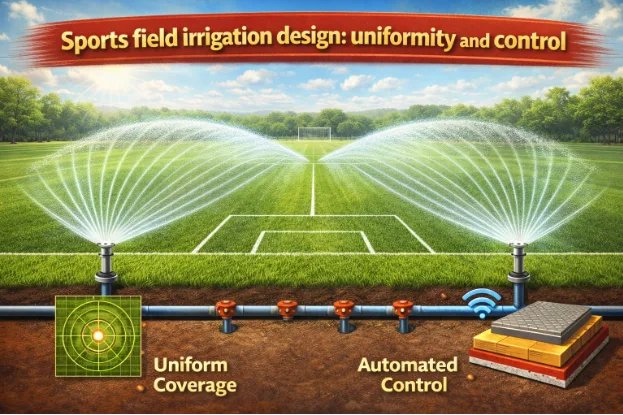
Sports field irrigation design focuses on achieving high uniformity (even water distribution across the field) and precise control (smart, automated application based on turf needs) to maintain a healthy, safe, and playable surface.
Why Uniformity and Control Matter in Sports Field Irrigation Design
Uniformity and control are paramount in sports field irrigation design because they directly impact playing surface quality, safety, water conservation, and cost-effectiveness.
Uniformity: The Foundation of a Quality Playing Surface
Uniform water application ensures that the entire field receives the same amount of moisture, leading to consistent turf health across the playing area.
-
- Consistent Turf Density and Quality: Patches of dry or waterlogged grass are eliminated, ensuring an even, resilient playing surface.
-
- Optimal Field Performance: A uniform surface provides a predictable bounce and roll for balls, which is essential for fair play and adherence to sport-specific rules.
-
- Improved Safety: Uniform turf reduces hard spots and uneven footing, minimizing the risk of athlete injuries such as sprains and falls.
Control: Efficient Management and Resource Optimization
Precise control over the irrigation system allows groundskeepers to apply the right amount of water exactly where and when it is needed .
-
- Water Conservation: Zoned control, often leveraging data from sensors, prevents overwatering and minimizes runoff, leading to significant water savings.
-
- Disease Prevention: Overly wet areas foster fungal growth and disease, while dry spots lead to wilt and stress; controlled irrigation prevents both, promoting a healthier field.
-
- Cost-Effectiveness: Efficient water use lowers utility bills, and healthy turf requires fewer chemical treatments (fertilizers, pesticides), reducing operational costs.
-
- Flexibility and Responsiveness: Advanced control systems (e.g., smart controllers, central control systems) allow for real-time adjustments based on weather conditions, soil moisture levels, and game schedules, ensuring the field is always ready for use.
The Role of Uniform Water Distribution in Sports Field Performance
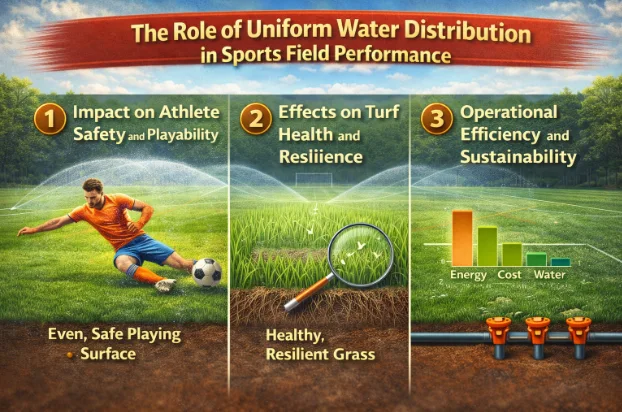
Uniform water distribution, measured as Distribution Uniformity (DU), is a critical factor in sports field management, directly impacting athlete safety, turf health, and operational costs.
Impact on Athlete Safety and Playability
-
- Surface Evenness: Inconsistent watering creates localized dry spots or waterlogged “soft spots,” which disrupt the ball’s roll and can cause players to lose footing.
-
- Injury Prevention: Proper hydration provides a “cushioning effect,” softening the surface to reduce impact-related injuries. Approximately 15% of concussions in football and soccer are caused by head-to-surface impact, highlighting the need for consistent surface hardness.
-
- Temperature Regulation: Uniform, healthy turf naturally cools the field through transpiration, reducing the risk of heat strokes and muscle cramps on hot days.
Effects on Turf Health and Resilience
-
- Root Development: Even moisture levels promote deeper, robust root systems, whereas uneven distribution leads to shallow roots and thin, brittle turfgrass in under-watered areas.
-
- Wear Tolerance: Consistent irrigation enhances the turf’s cellular strength, allowing it to withstand heavy traffic and recover faster from the wear and tear of matches.
-
- Disease Prevention: Over-watering in specific zones can lead to waterlogging, which displaces oxygen and makes root systems vulnerable to disease and decay.
Operational Efficiency and Sustainability
-
- Resource Conservation: High DU (e.g., 90%) ensures that no water is wasted on runoff or deep percolation while trying to saturate dry patches. Optimized DU can reduce water consumption by up to 30%.
-
- Reduced Maintenance: Uniformity eliminates the need for manual “hose-watering” of dry spots and reduces long-term repair costs associated with re-seeding patchy areas.
-
- Smart Technology: Modern systems use soil moisture sensors and weather-based controllers to maintain this uniformity automatically, adjusting for factors like wind and evaporation.
The Key Principles of Sports Field Irrigation Design
Key principles for sports field irrigation design focus on creating safe, playable surfaces using water efficiency, uniformity, and sustainability, integrating smart technology (sensors, weather data), optimizing head placement (off-field, away from high traffic), ensuring adequate pressure/flow, and coupling with excellent drainage for optimal grass health and cost savings, often using morning watering for absorption.
Core Principles & Considerations:
-
- Water Efficiency & Sustainability:
-
- Smart Technology: Use weather-based controllers, soil moisture sensors, and rain sensors to water only when needed, preventing waste.
-
- Rainwater Harvesting: Incorporate tanks to use collected rainwater as a sustainable, cost-effective source.
-
- Wind Management: Schedule irrigation during calm mornings to minimize drift and evaporation.
-
- Water Efficiency & Sustainability:
-
- Field Safety & Performance:
-
- Head Placement: Place sprinkler heads in non-play areas (e.g., off-field, near sidelines) to avoid hazards and wear.
-
- Uniformity: Ensure even water distribution with proper head spacing (often square/triangle patterns) and matching precipitation rates.
-
- Pressure Management: Design for sufficient dynamic pressure and flow (GPM) for optimal nozzle performance.
-
- Slow Closure Valves: Use slow-closing valves to prevent water hammer, protecting pipes and equipment.
-
- Field Safety & Performance:
-
- Integration with Drainage:
-
- Irrigation + Drainage: Design irrigation and drainage systems together for complete water management, as good drainage prevents waterlogging.
-
- Surface & Subsurface: Combine surface grading (slopes) with subsurface drainage (pipes, gravel) for effective water removal.
-
- Integration with Drainage:
-
- System Design & Placement:
-
- Mainlines/Valves: Bury main lines and place valve boxes off the field to prevent disruption.
-
- Hose Bibs/Quick Couplers: Install accessible quick-coupler valves for targeted watering of problem spots.
-
- System Design & Placement:
-
- Turf & Climate:
-
- Grass Type: Match irrigation needs to the chosen turfgrass (e.g., ryegrass needs more water than some warm-season grasses).
-
- Local Climate: Design to handle local conditions (drought, heavy rain).
-
- Turf & Climate:
Common Irrigation Design Mistakes and How to Avoid Them
Designing an efficient irrigation system requires careful planning to prevent water waste, plant stress, and high utility costs. Below are common irrigation design mistakes and practical ways to avoid them.
1. Poor Zoning (Hydrozoning)
-
- The Mistake: Grouping plants with different water needs on the same zone (e.g., watering high-thirst turf grass and drought-tolerant shrubs on the same schedule).
-
- The Fix: Implement hydrozoning. Group plants by their water requirements, soil type, and sun exposure into separate zones.
2. Incorrect Sprinkler Head Placement & Spacing
-
- The Mistake: Placing heads too far apart or at poor angles, leading to “dry spots” where water does not reach.
-
- The Fix: Aim for “head-to-head” coverage, where the spray from one head reaches the base of the next one. Use flags to mark and test placements before permanent installation.
3. Ignoring Water Pressure and Flow Rate
-
- The Mistake: Designing a system without measuring the property’s actual water pressure. Low pressure causes heads not to pop up fully; high pressure causes “misting” where water evaporates before hitting the ground.
-
- The Fix: Measure water pressure and flow rate (gallons per minute) at the source before finalizing the design. Install pressure regulators to maintain a consistent, optimal range.
4. Improper Pipe Sizing and Depth
-
- The Mistake: Using pipes that are too small, which creates excessive friction and drops pressure, or burying pipes too shallowly, making them vulnerable to damage from lawnmowers and frost.
-
- The Fix: Consult a pipe sizing chart to match pipe diameter to your flow requirements. Bury pipes at the recommended local depth (typically 8–12 inches for lateral lines).
5. Neglecting Future Landscape Growth
-
- The Mistake: Placing heads or drip lines based on current plant sizes without accounting for future growth. Large shrubs or trees eventually block spray patterns.
-
- The Fix: Anticipate plant maturity. Select adjustable heads or leave extra tubing in drip systems to allow for repositioning as plants grow.
6. Skipping Critical Components
-
- The Mistake: Omitting filters and backflow preventers. Lack of filters leads to clogged emitters, while missing backflow preventers can contaminate your home’s drinking water.
-
- The Fix:
-
- Filters: Install a filter with at least a 155-mesh screen to protect drip emitters.
-
- Backflow Preventers: Always install a backflow device (like those from Wilkins or FEBCO) as required by local codes.
-
- The Fix:
7. Incorrect Controller Programming
-
- The Mistake: Using a “set-it-and-forget-it” approach. Failing to adjust for seasons or using duplicate start times causes significant overwatering.
-
- The Fix: Invest in a Smart Irrigation Controller (e.g., Hunter Wi-Fi Smart Controller) that adjusts automatically based on local weather data.
8. Incompatible Thread Types
-
- The Mistake: Mixing Pipe Threads (NPT) and Hose Threads (GHT), which leads to leaks and cross-threading even if the sizes look similar.
-
- The Fix: Check labels for thread types. Use adapters specifically designed to transition between pipe and hose threads.
How to Monitor and Adjust Irrigation Design
To monitor and adjust irrigation design, regularly check for leaks, clogs, and coverage issues, using smart controllers, sensors (like soil moisture/ET), and visual inspections to fine-tune schedules for different zones based on plant needs, weather, and soil, while adjusting sprinkler heads and flow rates seasonally for optimal water efficiency and plant health.
Monitoring Techniques
-
- Water Usage & Bills: Look for unusual spikes indicating leaks.
-
- Visual Inspection: Check for dry spots, pooling water, or misaligned spray patterns.
-
- Soil Moisture Sensors: Provide real-time data on soil wetness to prevent overwatering.
-
- Evapotranspiration (ET) Sensors: Measure water loss from plants and soil due to weather (wind, temp, humidity) for precise adjustments.
-
- Smart Controllers: Automate schedules based on sensor data, weather forecasts, and local regulations.
-
- Flow Meters: Monitor water flow rate to detect blockages or leaks.
Adjustment Strategies
-
- Zoning: Group plants with similar water needs (sun/shade, soil type) into separate zones.
-
- Seasonal Adjustments: Reduce watering in cooler months and increase in hotter periods.
-
- Sprinkler Head Adjustment: Clean clogged heads and adjust nozzles for proper overlap and coverage (head-to-head).
-
- Flow Control: Use valve flow controls to fine-tune output and ensure proper pop-up height and spray pattern, as shown in this YouTube video.
-
- System Flushing: Periodically flush lines, especially the farthest ones, to clear debris and ensure clear water flow.
Key Design Principles for Adjustments
-
- Accurate Design: Start with correct calculations for flow rates, pressure, and pipe sizing.
-
- Right Components: Choose sprinkler heads and drip emitters suited for the area’s needs.
-
- Smart Technology Integration: Use smart controllers and sensors to minimize manual adjustments and conserve water.
Common Irrigation Design Challenges and How to Solve Them
Designing and maintaining an effective irrigation system involves overcoming several physical, environmental, and mechanical obstacles. Below are the most common irrigation design challenges and their 2025-standard solutions.
1. Pressure Imbalances (High/Low Pressure)
Pressure issues are the leading cause of system failure, leading to either “misting” (water loss to wind) or poor coverage.
-
- The Challenge: High pressure causes misting and premature component wear, while low pressure prevents sprinkler heads from popping up or reaching their intended distance.
-
- The Solution:
-
- High Pressure: Install pressure-regulating valves or heads to maintain optimal PSI (usually 30–40 PSI for spray heads).
-
- Low Pressure: Check for main line leaks or clogged filters. If the design is the issue, use larger diameter pipes to reduce friction loss or split one large zone into two smaller ones.
-
- The Solution:
2. Uneven Coverage (Dry Spots & Soggy Patches)
Poor distribution uniformity leads to “death zones” or waterlogged areas that rot roots.
-
- The Challenge: Obstructions (tall grass/shrubs), misaligned heads, or poor spacing.
-
- The Solution:
-
- Head-to-Head Coverage: Ensure the spray from one head reaches the base of the next.
-
- Alignment: Regularly realign heads that have tilted or settled into the soil.
-
- Nozzle Cleanup: Soak clogged nozzles in a vinegar solution to dissolve mineral deposits.
-
- The Solution:
3. Poor Zoning (Hydrozoning Failures)
Grouping plants with different water needs into the same zone is a frequent design error.
-
- The Challenge: Trees, turf, and desert shrubs on the same line will result in some plants being drowned while others starve.
-
- The Solution: Implement Hydrozoning. Group plants by water requirement, sun exposure, and soil type. Use separate valves for turf and garden beds.
4. Controller & Scheduling Errors
Even a perfect physical design fails if the “brain” of the system is misconfigured.
-
- The Challenge: “Factory default” resets after power surges or “stacking” multiple start times.
-
- The Solution:
-
- Smart Upgrades: Switch to Wi-Fi-enabled smart controllers that adjust schedules automatically based on real-time weather data.
-
- Cycle and Soak: For sloped or clay-heavy areas, program the controller for multiple short bursts (e.g., three 10-minute cycles) rather than one long 30-minute session to prevent runoff.
-
- The Solution:
5. Physical Damage & Wear
Irrigation components are exposed to harsh weather, lawnmowers, and animals.
-
- The Challenge: Cracked pipes from freezing or heads broken by foot traffic/machinery.
-
- The Solution:
-
- Winterization: Use compressed air to blow out lines before the first freeze.
-
- Protective Hardware: Use “swing pipe” (funny pipe) to connect heads to laterals, allowing the head to move if stepped on rather than snapping the pipe.
-
- The Solution:
6. Clogging in Drip Systems
Drip emitters have very small orifices and are highly prone to blockages.
-
- The Challenge: Mineral buildup, algae, or dirt entering through broken lines.
-
- The Solution: Install fine-mesh filters at the beginning of the zone and use self-flushing emitters. Periodically flush the lateral lines by opening the end caps while the water is running.
Every Drop Counts: Optimizing Water Usage with Uniform Irrigation Control
Optimizing water usage with uniform irrigation control is crucial for sustainability and crop health, as it ensures water is distributed evenly, minimizing waste and preventing issues like over- or under-watering. This approach maximizes efficiency and promotes water conservation.
Key Principles for Uniform Irrigation
-
- System Design and Maintenance: The foundation of uniform irrigation is a well-designed and regularly maintained system. This includes selecting appropriate sprinkler heads, drip emitters, or other components suited to your specific crop and soil type. Regular checks for leaks, clogs, or broken parts are essential to maintain consistent flow and pressure.
-
- Pressure Regulation: Maintaining consistent water pressure across the entire system is vital. Pressure variations lead to uneven distribution; areas with high pressure will expel more water than those with low pressure. Use pressure regulators and check valves to achieve a uniform operating pressure throughout the field or landscape.
-
- Scheduling: Effective irrigation scheduling involves determining the right amount of water to apply and the optimal timing. This requires understanding soil moisture levels, current weather conditions, and crop water needs. Utilizing modern tools like soil moisture sensors and local weather data helps inform precise scheduling decisions.
-
- Monitoring and Evaluation: Continuous monitoring allows for adjustments to be made as conditions change. Tools such as Catch Cans (used in a Water Uniformity Audit) help measure the distribution uniformity of sprinkler systems, providing data to identify and correct inefficiencies.
Tools and Resources
-
- Soil Moisture Sensors: These devices provide real-time data on soil water content, helping prevent both over- and under-watering.
-
- Weather Stations and Evapotranspiration (ET) Data: Local weather data and ET estimates help determine how much water has been lost from the soil and plants, informing irrigation needs.
-
- Irrigation Audits: Performing regular audits can identify inefficiencies and recommend improvements to your system’s design and operation. You can learn more about assessing your system’s efficiency from resources like the University of California’s Division of Agriculture and Natural Resources.
-
- Smart Controllers: These devices automate scheduling based on real-time weather and soil data, significantly optimizing water usage.
Design Smarter, More Efficient Sports Field Irrigation Systems with JMR InfraSolutions
Achieving irrigation uniformity and precise water control is critical to maintaining safe, high-performance sports fields. JMR InfraSolutions provides end-to-end sports field irrigation design solutions, combining hydraulic engineering, smart automation, and turf science to deliver consistent coverage and optimal water efficiency.
From stadiums and training grounds to academies and community fields, JMR designs and implements irrigation systems that enhance turf health, playability, and long-term field durability, while reducing water waste and operating costs.
Partner with JMR InfraSolutions for expertly engineered sports field irrigation design focused on uniformity and control.
Talk to our specialists today to plan a future-ready irrigation system for your sports facility.