
Smart irrigation systems with IoT sensors for stadiums

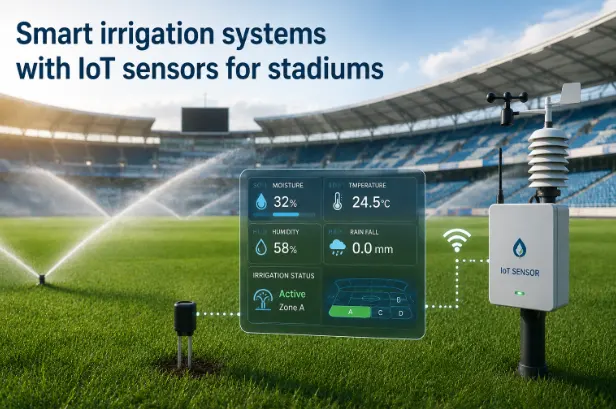
Smart irrigation systems for stadiums use Internet of Things (IoT) sensors to monitor real-time turf and environmental conditions, enabling precise, automated water application to maintain optimal field quality while significantly reducing water consumption and operational costs.
What Is a Smart Irrigation System for Stadiums?
A smart irrigation system for stadiums uses sensors (soil moisture, weather) and software to automatically adjust watering schedules, delivering precise water amounts only when needed for perfect turf, reducing waste, detecting leaks, and allowing remote control for high-pressure, dynamic field management. Unlike old timers, these systems adapt to real-time conditions (rain, evapotranspiration, usage) for healthier, consistent playing surfaces and significant water savings.
The Role of IoT Sensors in Stadium Irrigation Management
IoT sensors play a pivotal role in stadium irrigation management by enabling real-time data collection, automated decision-making, and remote control of watering systems. This approach moves beyond inefficient manual or timer-based methods to ensure optimal turf health while conserving water and energy resources.
Key Functions and Benefits
-
- Data Collection: A network of connected sensors gathers crucial environmental and soil data.
-
- Soil moisture sensors measure the water content in the root zone to determine actual watering needs, preventing both over- and under-watering.
-
- On-site weather stations or integration with local meteorological data services provide real-time information on rainfall, temperature, humidity, wind speed, and solar radiation (evapotranspiration rates).
-
- Flow and pressure sensors monitor the water distribution system to detect leaks, clogs, or abnormal flow rates, allowing for immediate maintenance and preventing water loss or equipment damage.
-
- Data Collection: A network of connected sensors gathers crucial environmental and soil data.
-
- Automated and Data-Driven Control: The collected data is sent to a central, cloud-based platform where intelligent algorithms analyze it and adjust irrigation schedules dynamically. This automation ensures water is applied precisely when and where needed, without manual intervention.
-
- For example, if the system detects sufficient soil moisture after a rain event, the scheduled irrigation cycle is automatically paused or skipped.
-
- Advanced systems may use AI and machine learning to predict future water needs based on historical data and weather forecasts, further optimizing planning.
-
- Automated and Data-Driven Control: The collected data is sent to a central, cloud-based platform where intelligent algorithms analyze it and adjust irrigation schedules dynamically. This automation ensures water is applied precisely when and where needed, without manual intervention.
-
- Remote Monitoring and Management: Stadium groundskeepers and facility managers can access the system via a web or mobile application (dashboard) from anywhere in the world. This allows them to:
-
- Monitor current field conditions and system performance in real time.
-
- Receive instant alerts and notifications about potential issues (e.g., mainline breaks, motor failure).
-
- Manually override the system or adjust parameters for specific zones if necessary.
-
- Remote Monitoring and Management: Stadium groundskeepers and facility managers can access the system via a web or mobile application (dashboard) from anywhere in the world. This allows them to:
Overall Impact
The implementation of IoT sensors in stadium irrigation results in significant operational and environmental benefits:
-
- Water Conservation: By applying only the necessary amount of water, these systems can reduce water consumption by 30-50% compared to traditional methods.
-
- Cost and Energy Savings: Reduced water usage directly lowers utility bills. Pumps and motors run only when necessary, saving energy and operational costs.
-
- Improved Turf Quality: Precise, data-driven irrigation promotes a healthier, more resilient playing field, ensuring optimal conditions for sports events.
-
- Sustainability: This technology supports sustainable water management practices, helping stadiums reduce their environmental footprint and align with global sustainability efforts.
The Key Components of IoT-Based Stadium Irrigation Systems
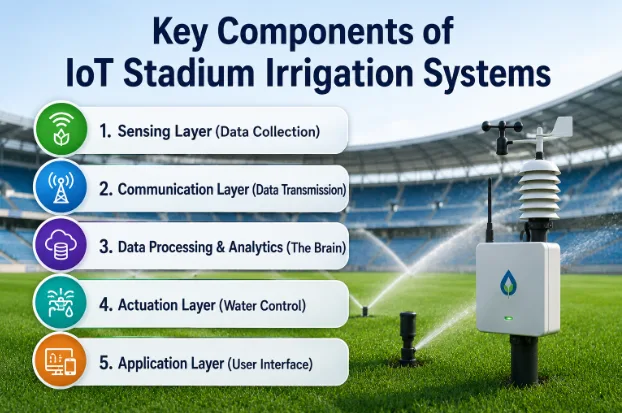
An IoT stadium irrigation system uses sensors (soil moisture, weather), Wireless Communication (Wi-Fi, LoRa), Edge/Cloud Processing (gateways, analytics), and Actuators (smart valves, pumps) to gather real-time data, analyze it with AI/ML, and automatically deliver precise water amounts, all managed via mobile/web apps for maximum efficiency, water saving, and lush turf.
Key Components of IoT Stadium Irrigation Systems:
-
- Sensing Layer (Data Collection):
-
- Soil Sensors: Measure moisture, temperature.
-
- Weather Sensors: Monitor rain, humidity, wind, light (integrated weather stations).
-
- Water Sensors: Flow meters to track water usage.
-
- Sensing Layer (Data Collection):
-
- Communication Layer (Data Transmission):
-
- Wireless Protocols: Wi-Fi, LoRaWAN, Zigbee for connecting devices.
-
- IoT Gateways: Collect data from sensors and send it to the cloud.
-
- Communication Layer (Data Transmission):
-
- Data Processing & Analytics (The Brain):
-
- Microcontrollers/Edge Devices: Local processing (e.g., Raspberry Pi, ESP32).
-
- Cloud Platform: Stores and processes large datasets.
-
- AI/ML Algorithms: Analyze data, predict needs, and generate optimal watering schedules.
-
- Data Processing & Analytics (The Brain):
-
- Actuation Layer (Water Control):
-
- Smart Valves: Electronically controlled valves for zones.
-
- Pumps: Automated pumps to deliver water.
-
- Sprinklers/Drip Systems: The final delivery mechanism.
-
- Actuation Layer (Water Control):
-
- Application Layer (User Interface):
-
- Mobile/Web Apps: For remote monitoring, control, and alerts (SMS, push).
-
- Dashboards: Visualizing data and system status.
-
- Application Layer (User Interface):
How it Works:
Sensors collect data (dry soil, sunny day), send it via gateway to the cloud, where AI decides exactly when and how much to water, then commands smart valves to activate, ensuring the turf gets what it needs without waste.
How Smart Irrigation and IoT Sensors Are Transforming Stadium
Smart irrigation and Internet of Things (IoT) sensors are transforming stadium pitch maintenance by enabling data-driven precision, significant water and energy conservation, and remote automation. These systems ensure optimal turf health while reducing operational costs and environmental impact, vital for creating sustainable venues.
How Smart Irrigation and IoT Work in Stadiums
Smart irrigation systems leverage a network of interconnected components to move beyond traditional, timed watering schedules.
-
- Data Collection: A variety of IoT sensors are strategically placed across the stadium pitch.
-
- Soil Moisture Sensors: These measure the real-time moisture content in the soil at different depths, indicating exactly when and where water is needed.
-
- Weather Stations: On-site or signal-based weather data (like evapotranspiration rates, rainfall, temperature, humidity, and wind speed) are collected to adjust schedules dynamically, preventing unnecessary watering during or after rain, or in high winds that cause uneven distribution.
-
- Flow Sensors: These monitor the volume of water passing through the system, enabling instant detection of leaks or malfunctions, which prevents significant water loss and damage.
-
- Data Collection: A variety of IoT sensors are strategically placed across the stadium pitch.
-
- Data Analysis and Automation: The data from the sensors is sent to a central, cloud-based platform. Intelligent algorithms analyze this information against the specific needs of the turf (soil type, grass species, etc.) to determine the precise amount and timing of irrigation. The system then automatically activates actuators, such as smart valves and pumps, to deliver water only when and where required.
-
- Remote Management and Control: Stadium facility managers can monitor the entire system and make adjustments via web-based dashboards or mobile apps from anywhere, eliminating the need for constant manual checks.
Transformative Benefits for Stadiums
The adoption of this technology offers several key advantages:
-
- Water Conservation: By applying water only when soil moisture drops below an optimal threshold and integrating weather forecasts, stadiums can reduce water consumption significantly, with some reports showing savings of 30-50% compared to traditional methods.
-
- Optimal Turf Health: Precise, data-driven watering eliminates the problems of over- or under-irrigation (which can cause root rot or crop stress), leading to more resilient, higher-quality playing surfaces.
-
- Cost and Energy Savings: Reduced water consumption directly lowers utility bills. Pumps and motors run only when necessary, saving energy and reducing operational costs.
-
- Operational Efficiency: Automation dramatically reduces the labor required for manual monitoring and irrigation tasks, allowing groundskeeping staff to focus on other critical maintenance activities.
-
- Environmental Sustainability: Smart irrigation helps stadiums align with broader environmental goals and sustainability initiatives by minimizing water wastage and reducing the facility’s carbon footprint, an increasingly important factor for modern sports venues.
The Key Considerations When Implementing IoT-Based Irrigation in Stadiums
Implementing IoT-based irrigation in stadiums in 2025 requires a balance between turf health, water conservation, and high-performance playability. Unlike general agriculture, stadium environments involve unique challenges such as microclimates, high-traffic compaction, and strict event scheduling.
The key considerations for implementation include:
1. Advanced Sensor Precision and Placement
-
- Root Zone Monitoring: Sensors must be placed specifically at the turfgrass root zone to measure moisture, temperature, and salinity levels in real-time.
-
- Microclimate Awareness: Large stadium structures create significant shadows and wind tunnels, leading to uneven drying. IoT systems must use multiple sensor nodes to manage these distinct “zones” independently.
-
- Wear Resistance: Sensors and actuators must be durable enough to withstand heavy equipment and high foot traffic from athletes and events.
2. Intelligent Data Integration
-
- Hyper-local Weather Forecasting: Integrating real-time weather data and 2025 predictive models allows the system to pause irrigation before rain events, preventing pitch saturation.
-
- Evapotranspiration (ET) Calculations: Systems should calculate water loss based on solar radiation, wind, and humidity to provide the exact replenishment needed, rather than following a static timer.
-
- Machine Learning (ML) Models: Using ML to analyze historical pitch data helps predict future water needs based on upcoming match schedules and anticipated turf stress.
3. Network Infrastructure and Connectivity
-
- Protocol Selection: Reliable communication is vital. Low-Power Wide-Area Networks (LPWAN) like LoRaWAN or Sigfox are often preferred for their ability to penetrate concrete stadium structures and cover large areas with minimal power.
-
- Cybersecurity: As stadiums become smarter, IoT devices become entry points for cyber threats. Implementing robust encryption and secure gateways is critical to protect facility management systems.
-
- Edge Computing: Processing data at the “edge” (on-site) ensures the system can make immediate irrigation decisions even if there is a temporary cloud connectivity outage.
4. Operational and Economic Factors
-
- Remote Management: Groundskeeper dashboards (accessible via mobile apps) allow for 24/7 monitoring and manual overrides during critical pre-game windows.
-
- Maintenance and Calibration: Sensors require regular calibration to prevent “drift” and ensure data remains accurate over multiple seasons.
-
- Sustainability Compliance: Many jurisdictions in 2025 require stadiums to report water usage. IoT systems automate this reporting, helping facilities meet ESG (Environmental, Social, and Governance) targets.
5. Hardware Interoperability
-
- Open vs. Proprietary Systems: Choosing between open-source IoT platforms (which offer flexibility but require more technical expertise) and turnkey commercial solutions is a major strategic decision.
-
- Integration with Existing Assets: The new IoT controllers should ideally be compatible with existing pumps, valves, and water storage systems to reduce total capital expenditure.
Saving Water, Saving Money: The Case for Smart Irrigation in Major Stadiums
Smart irrigation systems in major stadiums offer significant water and monetary savings, along with enhanced turf quality and operational efficiency. By leveraging sensor technology and data analytics, stadiums can precisely meet the turf’s needs, avoiding overwatering and reducing waste.
Water Savings and Environmental Benefits
-
- Significant Water Reduction: Smart irrigation systems can reduce water usage by 30% to 50% compared to traditional methods.
-
- Case Study: Manchester City FC: By upgrading their systems to capture and reuse rainwater, the club saved over 50 million liters of potable water and is on track to halve their overall water use.
-
- Targeted Watering: Real-time data from soil moisture sensors and weather forecasts ensures water is applied only where and when needed, minimizing runoff and evaporation and contributing to overall water conservation.
Financial Benefits and ROI
-
- Reduced Operational Costs: Beyond water bills, stadiums save on energy costs (less pumping) and labor due to automation and remote monitoring capabilities.
-
- Case Study: Ipswich City Council: A pilot program on sports fields saved $20,639 in water costs over six months, with a rapid payback period of just one year on an initial $40,000 system outlay.
-
- Rapid Return on Investment (ROI): The initial high investment is typically offset within one to three years through these cumulative savings.
-
- Potential Rebates: Many local water authorities and municipalities offer rebates and incentives for installing water-efficient technology, further reducing initial costs.
Enhanced Turf Quality and Playability
-
- Healthier Turf: Precise watering promotes optimal plant growth, leading to healthier, more resilient, and uniform turf quality.
-
- Consistent Playing Conditions: Proper soil moisture management ensures a consistent grip and ball roll, which is vital for professional sports playability.
Key Challenge
The primary challenge remains the high initial investment required for advanced technology and the need for staff technical knowledge, though declining component costs and incentives are mitigating factors.
Transform Stadium Irrigation System with Intelligent IoT-Driven Solutions by JMR InfraSolutions
Efficient stadium turf management starts with data-driven irrigation.
JMR InfraSolutions designs and implements smart irrigation systems powered by IoT sensors, giving stadium operators real-time visibility into soil moisture, weather conditions, and system performance so every drop of water is applied with precision.
By combining advanced automation, intelligent controls, and turf engineering expertise, JMR helps stadiums achieve consistent turf quality, lower water usage, and simplified operations across the entire playing surface.
Choose JMR InfraSolutions for smart stadium irrigation systems that deliver control, efficiency, and long-term performance.
Speak with our specialists to plan an IoT-enabled irrigation solution tailored to your stadium.