
Indoor Sports Flooring: PVC vs Wood vs PU

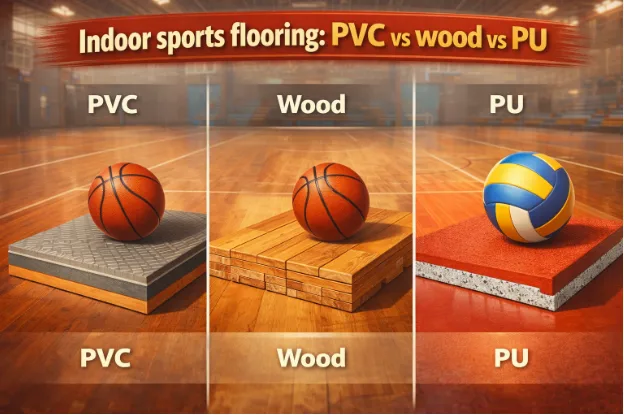
For indoor sports, PVC (Vinyl) offers great value, durability, and low maintenance, ideal for badminton/volleyball; Wood (Maple) provides premium performance, feel, and bounce for basketball but needs high upkeep; while Polyurethane (PU) is a versatile, durable synthetic coating over a rubber base, offering excellent shock absorption, durability, and low maintenance, making it a superior multi-sport choice over wood or PVC for safety and longevity.
The Key Factors to Consider When Selecting Indoor Sports Flooring
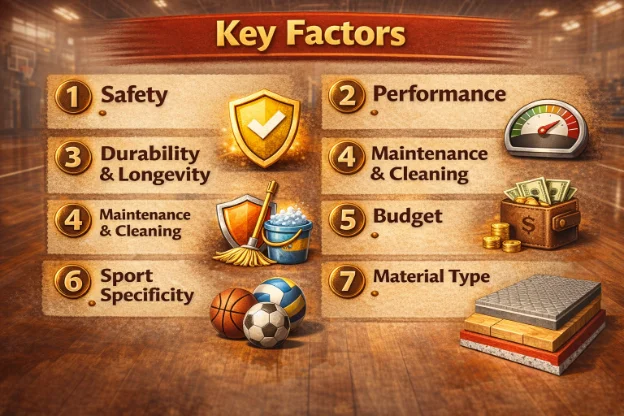
When choosing indoor sports flooring, prioritize Safety (shock absorption, slip resistance), Performance (elasticity, ball bounce), Durability (high traffic resistance, longevity), Maintenance (ease of cleaning), and Budget (initial cost vs. long-term upkeep), ensuring it’s fit for the specific sports played for optimal athlete comfort and injury prevention.
Key Factors:
-
- Safety:
-
- Impact Absorption: Reduces stress on joints and lowers injury risk (ASTM F2772 measures force reduction).
-
- Slip Resistance: Crucial for preventing falls and maintaining athlete control (surface finish effect).
-
- Safety:
-
- Performance:
-
- Elasticity/Shock Absorption: Provides comfort and energy return (vertical deformation).
-
- Ball Rebound: Consistent ball bounce is vital for sports like basketball and volleyball (ASTM F2772).
-
- Friction/Stretch: Proper friction for grip and movement.
-
- Performance:
-
- Durability & Longevity:
-
- Must withstand heavy use, foot traffic, and equipment without rapid wear.
-
- Durability & Longevity:
-
- Maintenance & Cleaning:
-
- Easy-to-clean surfaces save time and money, especially in high-use facilities.
-
- Maintenance & Cleaning:
-
- Budget:
-
- Consider initial cost, installation, and long-term maintenance/replacement.
-
- Budget:
-
- Sport Specificity:
-
- Different sports (basketball, volleyball, dance, weightlifting) have unique needs.
-
- Sport Specificity:
-
- Material Type:
-
- Wood: Classic, durable, good for basketball/dance.
-
- Vinyl/Polyurethane: Versatile, cost-effective, good moisture resistance, high-performance options.
-
- Rubber: Excellent shock absorption, good for weightlifting/general fitness.
-
- Material Type:
Beyond the Surface: Comparing Installation, Cost, and Maintenance of PVC, Wood, and Polyurethane (PU) Floors
PVC, wood, and polyurethane (PU) floors differ significantly in their installation complexity, initial cost, and long-term maintenance needs. PU is generally a high-performance, durable coating applied over a subfloor, while PVC and wood are plank or tile systems.
Comparison of PVC, Wood, and Polyurethane (PU) Flooring
| Feature | PVC Flooring | Wood Flooring | Polyurethane (PU) Flooring |
| Installation | Easy & Quick: Often available in simple click-lock or self-adhesive planks/tiles, making it possible for DIY installation with minimal downtime. | Complex & Time-Consuming: Requires meticulous subfloor preparation and skilled labor for a seamless, stable fit. Takes time to settle and often requires finishing on-site. | Specialized Application: Applied as a liquid coating over a prepared substrate (like concrete or a rubber base). Requires professional application to achieve a seamless, uniform finish and has a specific curing time (several days). |
| Cost | Lowest Initial Cost: Most economical option, with a wide range of pricing based on thickness and quality (approx. ₹45 to ₹250 per sq. ft. for materials). | Highest Initial Cost: Premium hardwood is a significant investment (approx. ₹400 to ₹1,500+ per sq. ft. for materials), plus substantial installation costs. | Mid to High Cost: Material costs vary, but professional application adds to the overall price. Offers excellent value in the long run due to low maintenance. |
| Maintenance | Very Low: Water-resistant and easy to clean with a mop or vacuum. Does not require special polishing or sealing, but is prone to scratches and fading in direct sunlight. | High: Requires regular cleaning, special care with moisture (most are not waterproof), and periodic professional sanding and refinishing every few years to maintain appearance and durability. | Very Low: Seamless and highly resistant to stains, chemicals, and wear. Easy to clean with mild, neutral pH cleaners. Does not require regular waxing or polishing. |
| Durability | Durable for daily wear but can show wear and tear in high-traffic commercial areas over time; non-biodegradable. | Long-lasting (can last decades if maintained), but susceptible to moisture damage, warping, dents, and scratches. | Extremely durable, flexible, UV-resistant, and impact-resistant, making it suitable for demanding environments like hospitals and industrial spaces. |
Key Takeaways:
-
- PVC is a cost-effective, low-maintenance choice for budget-conscious projects and areas with moderate traffic, especially where moisture resistance is needed.
-
- Wood offers unmatched natural aesthetic appeal and long-term value, but requires a significant upfront investment and commitment to regular, high-effort maintenance.
-
- PU is a superior performance solution, ideal for commercial or industrial settings, offering high durability and very low maintenance through its seamless, protective coating.
Long-Term Investment: Evaluating the Lifecycle Costs of PVC vs. Wood vs. Polyurethane Flooring
In a long-term investment analysis, Polyurethane (PUR)-reinforced flooring offers the lowest life cycle costs due to minimal maintenance requirements, while PVC provides a good balance of low initial and maintenance costs. Traditional wood flooring has a higher total cost over its lifespan due to significant maintenance needs.
Lifecycle Cost Evaluation
The primary factors in life cycle cost (LCC) are initial purchase and installation, ongoing maintenance, and longevity.
| Feature | PVC Flooring | Wood Flooring | Polyurethane (PUR) Flooring |
| Initial Cost | Low to mid-range; often comparable to wood. | Mid to high-range (solid wood is expensive; engineered wood is cheaper). | High initial cost, but delivers long-term value. |
| Maintenance | Minimal: simple cleaning with soap and water; highly scratch and moisture-resistant. | High: requires regular and periodic sanding, staining, and sealing to maintain appearance and prevent damage. | Minimal: very low maintenance, mainly standard cleaning. The reinforced surface makes it highly durable. |
| Durability/Longevity | Durable and resistant to rot, decay, and moisture; typically lasts 10-20 years. | Can last 50-100 years with meticulous and consistent maintenance, but prone to damage from moisture and impacts. | Extremely durable, especially in high-traffic commercial settings. A PUR-reinforced vinyl floor can last 30 years or more. |
| Vulnerability | Can dent under heavy objects and may fade or melt if exposed to high heat/direct sunlight. | Susceptible to moisture damage, warping, scratching, and insect infestations. | Highly resistant to wear and tear, chemicals, and moisture. |
Conclusion: Best Investment
-
- For the absolute lowest long-term total cost, especially in commercial or high-traffic areas, polyurethane-reinforced flooring is the most profitable investment. Its high initial cost is offset by significant savings in maintenance over several decades.
-
- For a balance of initial affordability and low ongoing costs in residential settings, PVC/vinyl flooring is a smart choice due to its high durability and minimal upkeep requirements.
-
- Wood flooring offers timeless aesthetic appeal but is a more expensive investment over its life cycle due to the continuous and costly maintenance (sanding, refinishing) needed to preserve its condition.
Bounce, Grip, & Glide: Analyzing Athletic Performance on PVC vs. Wood vs. PU Surfaces
Athletic performance varies significantly across PVC, wood, and polyurethane (PU) surfaces, primarily due to differences in material properties like energy return and shock absorption. Wood offers a firm, traditional feel, while PVC and PU provide more cushioning and engineered grip for injury prevention.
Bounce, Grip, and Glide Analysis
| Feature | Wood (Solid Hardwood Maple) | PVC (Polyvinyl Chloride) | PU (Polyurethane) |
| Bounce | High & Consistent. The firmness of the surface provides high and predictable energy return, making it the standard for professional basketball courts. | Predictable. PVC offers excellent energy return and a consistent ball bounce, often meeting or exceeding 90% rebound in standard tests. | Consistent & Resilient. The inherent resilience and elasticity of PU ensure uniform ball bounce and surface responsiveness. |
| Grip | Moderate. The grip can be excellent when clean and dry but becomes very slippery when wet or dusty. Regular refinishing is required to maintain optimal grip. | Excellent & Predictable. The surface is highly engineered with specific textures to provide predictable grip for quick starts, stops, and dynamic movements, helping prevent slips and falls. | Optimal Traction Control. PU surfaces are designed to provide an ideal balance of grip and slide, offering stability during rapid acceleration and changes in direction. |
| Glide | Smooth but firm. Athletes can slide in a controlled manner, though the impact is high, as the floor absorbs little energy. | Controlled. The engineered texture of PVC allows for controlled “glide” (sliding coefficient of friction) to reduce injury risk while allowing quick movement. | Balanced. Provides a secure footing with enough “give” to allow natural athletic movements without excessive or abrupt stopping. |
Impact on Athletic Performance
-
- Wood is favored for professional basketball and volleyball due to its traditional feel and consistent, high ball response. However, it offers less shock absorption, which can lead to increased joint strain and a higher risk of injury over time compared to synthetic options.
-
- PVC is a versatile and popular choice for multi-purpose indoor sports halls, including badminton and basketball. Its superior shock absorption properties help cushion impact and minimize the risk of muscle and joint injuries, making it a safer option for athletes during high-impact activities.
-
- PU is considered an excellent all-arounder, offering a balance of high shock absorption, durability, and a seamless finish. It is widely used for athletic tracks and multi-sport courts as it is designed to disperse impact forces and enhance traction control, thereby preventing injuries while enabling dynamic, high-performance play.
Turnkey Indoor Sports Flooring Solutions by JMR Infrasolutions
JMR InfraSolutions provides end-to-end turnkey solutions for indoor sports flooring, managing projects from initial design and concept to engineering and final delivery. Their services are designed for a variety of environments, including multi-use gyms, competitive basketball courts, and yoga studios.
Key Flooring Solutions & Features
JMR InfraSolutions offers a diverse range of high-performance surfaces tailored to specific athletic requirements:
-
- Multi-Purpose Flooring: Specialized surfaces designed for gyms and recreational areas that balance durability with performance.
-
- Synthetic & PVC Surfaces: Ideal for indoor courts like badminton, volleyball, and basketball, providing critical features like shock absorption, anti-slip textures, and rebound resilience.
-
- Rubber Flooring: High-impact options including 10mm to 25mm thickness tiles or mats, suitable for heavy-duty gym environments to reduce noise and protect subfloors.
-
- Advanced Safety Features: Their solutions prioritize athlete safety through anti-microbial treatments, wear-resistance, and noise-proofing.
Comprehensive Turnkey Services
Beyond just supplying material, the company acts as a single-point partner for sports infrastructure:
-
- Project Management: Overseeing every phase including planning, construction, and irrigation or lighting integration.
-
- Customization: Tailoring floor designs to meet specific project dimensions and performance standards.
-
- Modular Solutions: Utilizing modular construction methods to accelerate timelines without sacrificing durability.
-
- Sustainability: Focusing on eco-friendly methods and recyclable materials in their development process.
Build High-Performance Indoor Sports Facilities with JMR InfraSolutions
Looking to install safe, durable, and competition-ready indoor sports flooring?
JMR InfraSolutions delivers end-to-end indoor sports flooring solutions from PVC, wooden, to PU systems engineered for performance, player safety, and long-term value.
With proven expertise in sports infrastructure design, material selection, and precision installation, JMR ensures every indoor court meets international standards, usage demands, and lifecycle efficiency goals.
Partner with JMR InfraSolutions to design and build indoor sports floors that enhance playability, reduce maintenance, and stand the test of time.
Contact us today to discuss your indoor sports facility requirements.