
What is LED Stadium Lighting Retrofit ROI?

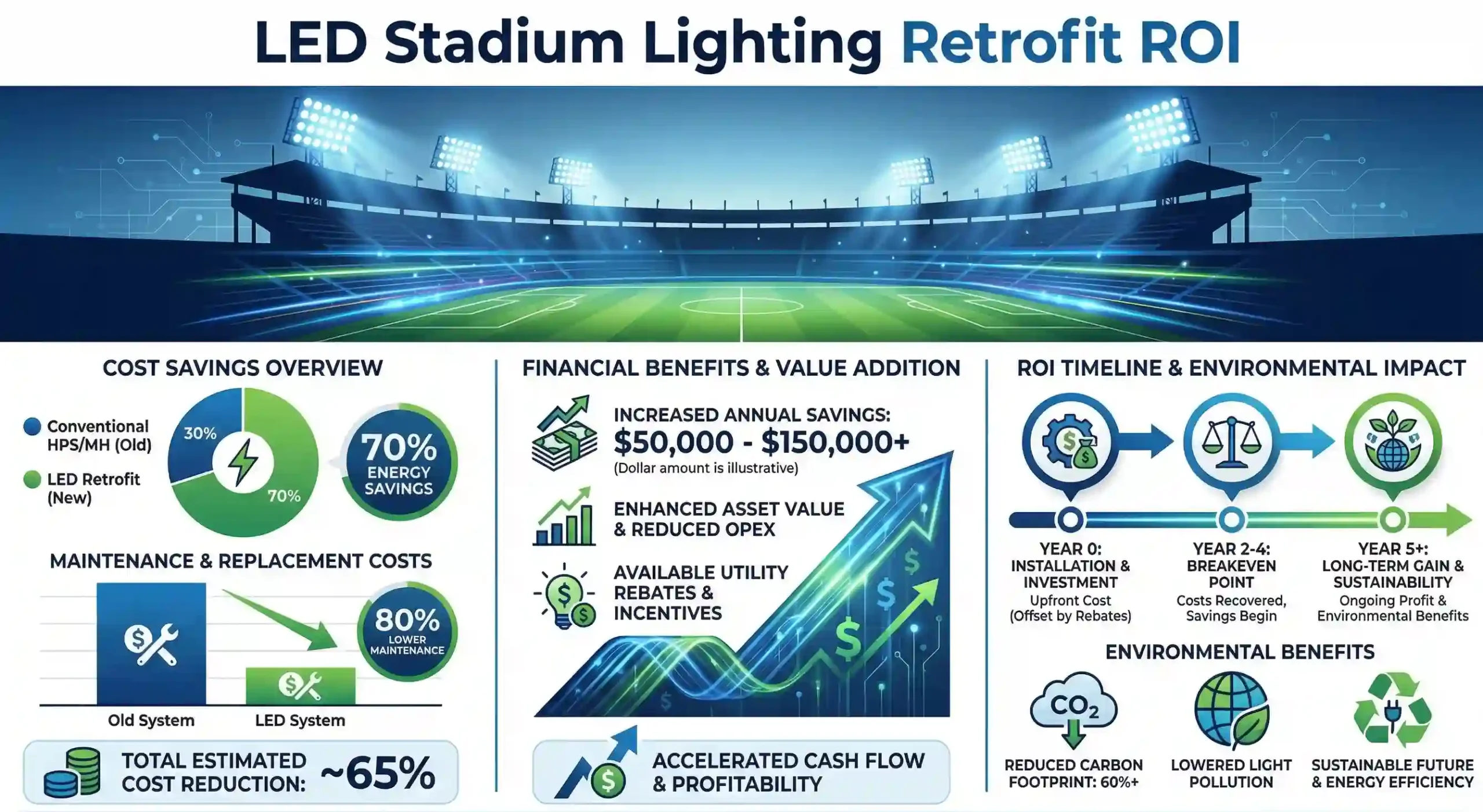
LED stadium lighting retrofit ROI is the return on investment calculated from the initial cost of replacing an old stadium lighting system with LEDs, measured by the total annual savings from reduced energy and maintenance costs. It quantifies how quickly the upgrade pays for itself and demonstrates the project’s profitability, with payback periods often ranging from one to seven years depending on the venue’s usage, energy rates, and available incentives.
What are the key components of LED Stadium Lighting Retrofit?
The key components for an LED stadium lighting retrofit include the LED light fixtures themselves, a robust power supply system with surge protection, and a sophisticated control system for managing lighting levels.
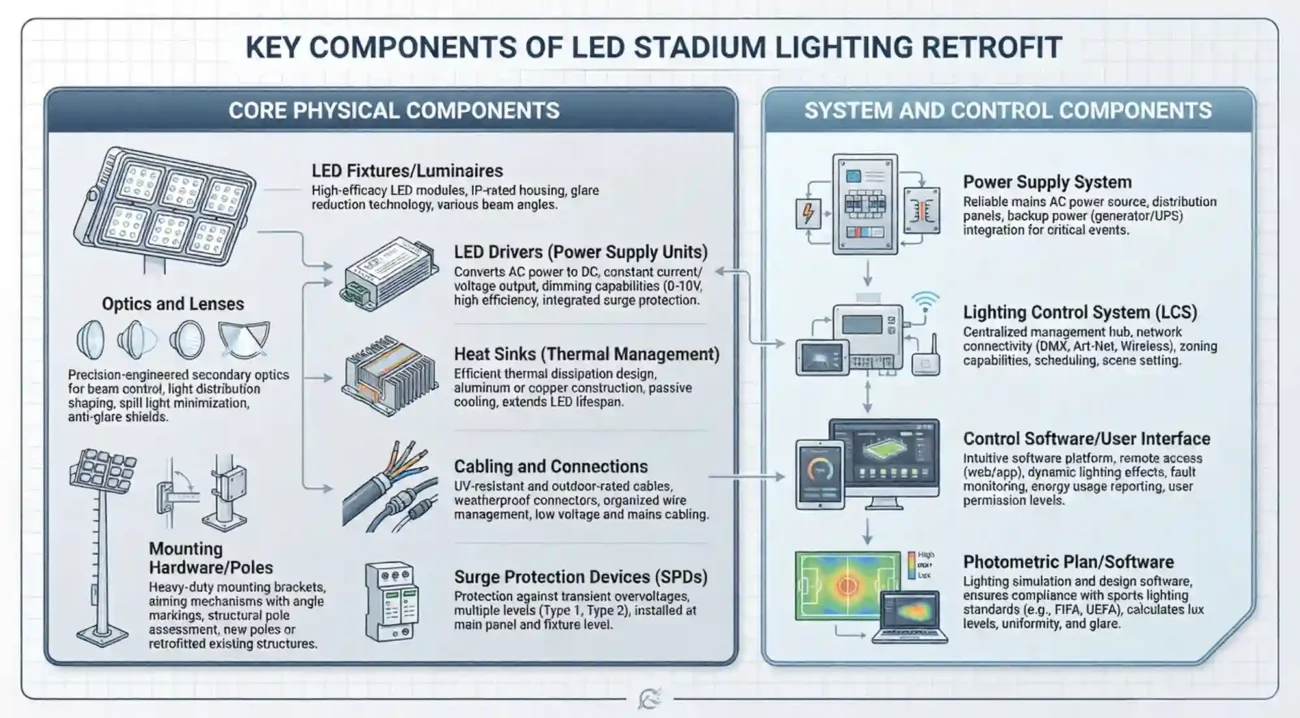
Core Physical Components
-
- LED Fixtures/Luminaires: These are the primary components that produce the light. For stadiums, high-power floodlights with specific wattages (e.g., 500W to 2000W) are used.
-
- LED Drivers: Often considered the “brain” of the bulb, the driver is a crucial component that converts the incoming AC power to the DC power suitable for the LEDs, ensuring a steady and flicker-free current.
-
- Optics/Lenses: High-end lens design and optics are vital for controlling the beam angle and light distribution to ensure uniform illumination across the field while minimizing glare for players and spectators.
-
- Heat Sinks: LEDs generate internal heat at the junction, which must be dissipated to maintain performance and lifespan. The heat sink (often part of the fixture housing, made of a thermally conductive material like aluminum) draws this heat away.
-
- Mounting Hardware/Poles: Existing poles must be assessed for their load-bearing capacity and height suitability for the new fixtures. New or reinforced mounting hardware may be needed to secure the lights correctly and achieve optimal light placement.
-
- Cabling and Connections: Proper, weatherproof wiring and connections (rated IP65 or higher for outdoor use) are essential for reliable power and data transfer, especially in a large, exposed environment.
-
- Surge Protection Devices: Given the high value of the equipment and the exposure of tall poles to the elements, robust surge protection should be installed at the breaker and the pole base to protect the system from power spikes.
System and Control Components
-
- Power Supply System: A stable and robust power infrastructure is needed to support the new electrical load and ensure consistent power to avoid flickering.
-
- Lighting Control System: Modern LED retrofits often include smart controls that allow for dynamic adjustment of brightness levels, color temperature, and scheduling, often via wired or wireless (WiFi, Bluetooth, or Ethernet-based) interfaces.
-
- Control Software/User Interface: Software allows operators to manage the lighting system, monitor energy usage, and even program dynamic lighting effects for different events.
-
- Photometric Plan/Software: While not a physical component, a detailed photometric analysis and plan developed with specialized software is a crucial part of the retrofit process to design the optimal layout and ensure lighting standards (e.g., foot-candle requirements for specific sports) are met.
What are the Benefits in an LED Stadium Lightning Retrofit?
The benefits of an LED stadium lighting retrofit include significant energy and cost savings, reduced maintenance, and superior lighting performance. Upgrades provide better visibility, instant-on brightness without warm-up time, and enhanced control for special effects, while also being more environmentally friendly due to lower energy consumption and longer lifespan.
Cost and energy savings
-
- Lower energy bills: LEDs use less electricity, leading to lower utility costs.
-
- Reduced maintenance: LEDs have a much longer lifespan than traditional bulbs, so replacement is needed far less frequently.
-
- Tax incentives: Facilities may qualify for tax deductions for improving energy efficiency through a retrofit.
Improved lighting performance
-
- Superior brightness: LEDs offer superior and consistent brightness that doesn’t degrade over time, unlike older HID lights.
-
- Instant-on: There is no warm-up time required for LEDs, providing full brightness immediately.
-
- Better color rendering: LEDs provide better color rendering, which is important for both players and spectators.
-
- Increased control: Modern LED systems can be controlled wirelessly to adjust brightness, create special effects, and change colors for events.
Environmental benefits
-
- Reduced carbon footprint: Using less energy lowers the strain on power plants, which in turn reduces greenhouse gas emissions.
-
- Mercury-free: LEDs are free of mercury, a toxic substance found in some older lighting technologies.
-
- Sustainability: Retrofitting is a more sustainable approach than a full replacement, as it is faster, easier, and reduces waste.
How to Maximize the Financial Return on Your LED Upgrade?
To maximize the financial return on your LED upgrade, you should adopt a comprehensive approach focusing on strategic planning, leveraging financial incentives, selecting high-efficiency products, and integrating smart controls.
Strategic Planning and Assessment
-
- Conduct a thorough energy audit: Assess your existing lighting system to identify areas with the highest energy consumption and potential for savings.
-
- Prioritize high-usage areas: Focus upgrades on areas with long operating hours (e.g., warehouses, parking garages, manufacturing floors) to achieve the quickest payback period.
-
- Set clear goals: Define specific energy reduction targets and financial goals (e.g., target ROI or payback period) to guide your decisions.
-
- Work with professionals: Partner with an energy-efficient lighting company or qualified electrical contractor who can provide a solution-based model and ensure proper installation, maximizing performance and warranty coverage.
Product Selection and Implementation
-
- Choose high-efficiency LED products: Select lights with high lumens per watt (lm/W) ratings to ensure maximum light output with minimal energy input.
-
- Opt for quality components: Invest in products from reliable manufacturers with good warranties to ensure longevity and avoid unexpected replacement costs later.
-
- Customize solutions: Avoid a “cookie-cutter” approach; select appropriate light levels and color temperatures for different tasks and environments to improve comfort, safety, and productivity.
-
- Consider a full fixture replacement: In some cases, replacing the entire fixture instead of using a retrofit kit may offer better long-term performance, efficiency, and warranty benefits.
Financial Incentives and Financing
-
- Research all available rebates and incentives: Check with local utility companies, government programs, and energy efficiency organizations for rebates and tax credits that can significantly offset initial costs. Use resources like the DSIRE (Database of State Incentives for Renewables & Efficiency).
-
- Explore financing options: Investigate options such as equipment financing, leasing, or “Light as a Service (LaaS)” models that can provide immediate energy savings with no upfront capital investment.
-
- Factor in all savings: When calculating your ROI, include not just energy cost savings, but also reduced maintenance and labor costs due to the longer lifespan of LEDs.
Operational Efficiency
-
- Integrate smart controls: Utilize lighting control systems like occupancy sensors, dimmers, light harvesting (optimizing natural light), and time-based scheduling to ensure lights are only used when and where needed.
-
- Maintain the system: Implement a routine maintenance schedule, including regular cleaning of fixtures, to maintain optimal light output and efficiency.
-
- Train staff: Ensure staff are trained on the best practices for using and maintaining the new lighting system to optimize usage patterns.
Why LED Is the Smart Long-Term Investment for Stadiums?
LEDs are a smart long-term investment for stadiums due to significant energy savings, lower maintenance costs from their longer lifespan, and improved broadcast quality for modern media. They also offer enhanced safety for spectators and players, increased venue flexibility through smart controls, and environmental benefits that align with modern sustainability goals.
Financial benefits
-
- Reduced energy costs: LEDs can consume 50% to 75% less energy than traditional systems, leading to substantial savings on utility bills.
-
- Lower maintenance: The extremely long lifespan of LEDs (up to 100,000 hours) drastically reduces the frequency and cost of replacements and the associated downtime.
Performance and fan experience
-
- Superior broadcast quality: LEDs provide flicker-free, uniform illumination that is crucial for high-definition and 4K broadcasting, making every detail clear for cameras and replays.
-
- Enhanced player performance: Consistent, glare-free lighting improves visibility for athletes in fast-paced sports.
-
- Increased safety: Lighting can be balanced to ensure safe passage for fans in all areas of the stadium, while also providing the right light for players.
-
- Venue flexibility: Smart controls and dimming capabilities allow for dynamic lighting adjustments for different events, such as creating special effects or focusing light on specific areas.
Sustainability and environmental impact
-
- Reduced carbon footprint: LEDs contain no hazardous materials like mercury and consume far less energy, which helps reduce a stadium’s environmental impact.
-
- Alignment with CSR goals: The move to LED lighting demonstrates a commitment to sustainability and can help a stadium meet corporate social responsibility objectives.
How to Accelerate Your Payback Period with High-Efficiency LED Lighting?
Accelerating your payback period with high-efficiency LED lighting primarily involves maximizing the energy savings and leveraging available financial incentives. The key is to reduce both energy consumption and maintenance costs rapidly enough to offset the initial investment quickly.
Here is a breakdown of how to achieve a faster return on investment (ROI):
1. Maximize Energy Efficiency
The most significant factor in accelerating your payback period is reducing energy usage.
-
- Choose High Lumens Per Watt (LPW): When selecting LED products, prioritize those with high efficacy (lumens per watt) . Higher LPW means more light output for less electricity consumed, leading to greater savings on your energy bill.
-
- Implement Smart Controls: Do not just replace bulbs; upgrade the system. Utilize lighting controls to ensure lights are off when not needed:
-
- Occupancy/Vacancy Sensors: Automatically turn lights on when a room is in use and off when it is empty.
-
- Daylight Harvesting: Install sensors near windows to dim or turn off artificial lights when sufficient natural light is available.
-
- Scheduling/Zoning: Use programmable controls to manage lighting in different areas based on operational hours.
-
- Implement Smart Controls: Do not just replace bulbs; upgrade the system. Utilize lighting controls to ensure lights are off when not needed:
2. Leverage Financial Incentives
Reducing the initial upfront cost directly shortens the payback timeline.
-
- Utility Rebates and Incentives: Many utility companies offer substantial rebates for installing high-efficiency lighting. Check with your local energy provider to find eligible programs and maximize these savings.
-
- Government Tax Credits and Deductions: Look into federal, state, and local tax incentives designed to encourage energy efficiency upgrades for businesses or homeowners [1]. Programs like the Commercial Buildings Energy-Efficiency Tax Deduction (Section 179D) in the US can provide significant benefits.
-
- Financing Options (Leasing/PACE): Explore alternative financing methods, such as Property Assessed Clean Energy (PACE) programs or equipment leasing, which can structure payments around the energy savings achieved, making the upgrade cash-flow positive from day one.
3. Minimize Operating and Maintenance Costs
LEDs inherently reduce maintenance costs, but planning ensures these savings are realized quickly.
-
- Long-Term Reliability: LEDs last significantly longer than traditional lighting (up to 25 times longer than incandescents). This reduces the frequency of purchasing replacement bulbs and the labor costs associated with changing them.
-
- Strategic Replacements: When retrofitting, prioritize areas where maintenance is expensive or disruptive, such as high ceilings, manufacturing floors, or 24-hour operations. The saved labor costs here can significantly accelerate the ROI.
-
- Warranty: Select products with strong warranties. A robust warranty ensures that unexpected product failures during the initial payback period do not result in additional costs.
4. Optimize the Installation Process
-
- Conduct a Professional Audit: A thorough lighting audit will identify the most inefficient fixtures and provide an accurate projection of energy savings and payback periods, ensuring you target the areas that offer the fastest ROI.
-
- Ensure Correct Dimming Compatibility: Using dimmable LEDs with compatible dimmers prevents performance issues or premature failure that could increase maintenance costs
-
- By combining maximum energy savings with aggressive pursuit of incentives and reduced operational costs, the typical payback period for a commercial LED lighting upgrade can often be reduced to as little as 1 to 3 years.
Why Stadium Operators are Choosing LED Lighting?
Stadium operators are choosing LED lighting due to a combination of significant operational cost savings, superior performance and reliability, and enhanced fan and broadcast experiences. These benefits make LEDs a more efficient, sustainable, and modern solution compared to traditional metal halide or high-pressure sodium lighting systems.
Key Reasons for the Shift to LED Lighting
-
- Energy Efficiency & Cost Savings: LEDs consume significantly less electricity (50-75% less) than traditional lighting, leading to substantial reductions in utility bills and operational costs. This energy saving also helps stadiums meet sustainability goals and reduce their carbon footprint.
-
- Long Lifespan & Low Maintenance: LED lights have an exceptionally long operational life, often lasting 50,000 to 100,000 hours, which is several times longer than traditional bulbs. This drastically reduces the frequency of replacements and maintenance, saving time and labor costs associated with climbing tall stadium poles.
-
- Superior Light Quality & Visibility:
-
- Uniformity: LEDs provide even, consistent light distribution across the entire field, eliminating dark spots, shadows, and glare that can affect player performance and spectator visibility.
-
- High Color Rendering Index (CRI): With a high CRI (typically >80), LEDs accurately render colors, which improves clarity for both in-person viewing and high-definition (HD) or 4K television broadcasts.
-
- Superior Light Quality & Visibility:
-
- Instant On/Off Capability: Unlike traditional lights that require several minutes to warm up and reach full brightness, LED lights turn on and off instantly. This feature is essential for immediate starts, managing emergencies, and creating dynamic pre-game light shows and special effects.
-
- Smart Controls Integration: Modern LED systems are compatible with smart lighting controls and Internet of Things (IoT) integration. This allows operators to remotely manage, dim, schedule, and customize lighting levels and colors for different events (e.g., a football game vs. a concert), optimizing energy use and enhancing the event atmosphere.
-
- Durability & Safety: LEDs are built with sturdy components that are resistant to shock, vibrations, and various weather conditions (rain, wind, extreme temperatures). They also produce very little heat, which minimizes the risk of fire hazards.
-
- Environmental Benefits: LEDs are mercury-free and fully recyclable, making them a more environmentally friendly choice compared to some older lighting technologies that contain hazardous materials.