
How Sports Infrastructure Drives Community Development

Modern sports infrastructure serves as a powerful engine for local transformation, acting as a catalyst for economic growth, public health, and social unity. When municipalities and private developers invest in robust facilities, they create more than just playing fields. They build essential hubs that foster civic pride, drive tourism, and provide safe environments for athletic progression. Understanding how sports infrastructure drives community development requires a focus on sustainable facility design and high quality execution that stands the test of time.
At JMR InfraSolutions, we specialize in delivering comprehensive sports infrastructure solutions that bridge the gap between architectural vision and tangible community impact. By prioritizing durable materials and advanced engineering, we help project owners maximize their long term return on investment while ensuring every facility meets international safety and performance standards.
What Is Sports Infrastructure?
Sports infrastructure refers to the facilities and systems built to support sports, recreation, and athletic training. It includes stadiums, sports complexes, training grounds, playing fields, indoor arenas, swimming pools, seating systems, lighting, scoreboards, and other supporting amenities.
These facilities provide spaces for athletes to train and compete while also encouraging community participation, promoting healthy lifestyles, and supporting local economic and social development.
Key Components of High Impact Sports Complexes
A successful facility integrates multiple specialized systems to ensure functionality and versatility. From the foundation to the final finish, every element must be engineered for longevity and user safety. High impact complexes rely on a mix of structural integrity and modern amenities to serve both professional athletes and the general public.
Key components that define top tier complexes include:
- High performance turf solutions designed for durability and optimal player performance.
- Energy efficient sports lighting systems that ensure visibility and minimize operational costs.
- Ergonomic stadium seating solutions that prioritize spectator comfort and safety.
- Integrated LED display solutions that enhance the live fan experience.
The Connection Between Sports Infrastructure and Community Development
Sports infrastructure plays a key role in community development by creating spaces that encourage physical activity, social interaction, and economic growth. Facilities such as stadiums, sports complexes, and recreational grounds bring people together, promote healthier lifestyles, and support youth engagement.
These venues also stimulate local economies by attracting events, creating jobs, and supporting nearby businesses. When planned effectively, sports infrastructure becomes a community hub that strengthens social connections, improves quality of life, and contributes to long-term urban development.
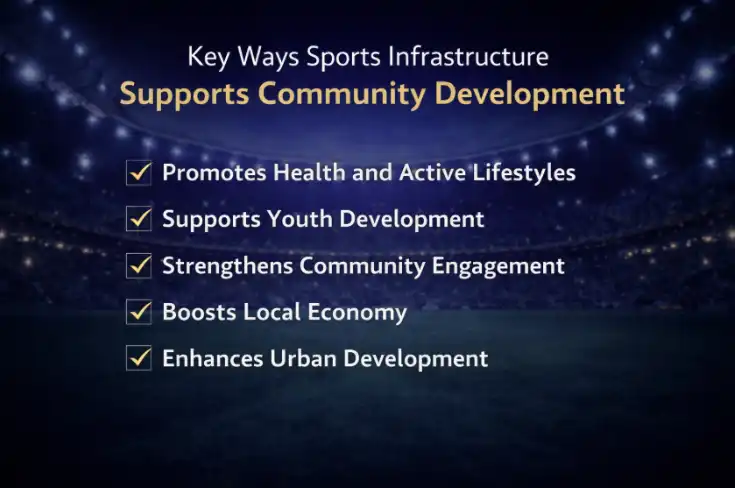
Key Ways Sports Infrastructure Supports Community Development
Sports infrastructure ranging from neighborhood parks and local gyms to multipurpose stadiums acts as a cornerstone for community development by merging social, health, and economic objectives. Beyond being just “places to play,” these facilities function as active community hubs that drive several key areas of growth.
- Promotes Health and Active Lifestyles
Accessible sports facilities encourage people to participate in physical activities, improving overall health and well-being. - Supports Youth Development
Sports complexes and training centers provide young athletes with opportunities to develop skills, discipline, and teamwork. - Strengthens Community Engagement
Sporting events and local tournaments bring people together, fostering social connections and community pride. - Boosts Local Economy
Sports venues attract events and visitors, creating jobs and supporting local businesses such as hotels, restaurants, and retail outlets. - Enhances Urban Development
Well-planned sports infrastructure contributes to modern city planning, improved public spaces, and smart city initiatives.
The Role of Turnkey Sports Infrastructure Development
Turnkey sports infrastructure development provides a single-source solution covering design, construction, and maintenance, accelerating project timelines and ensuring high-quality, international-standard facilities. By centralizing responsibility, this approach reduces administrative burdens, hidden costs, and operational risks for clients, allowing for faster, cost-effective delivery.
- End-to-End Project Management
Turnkey providers handle the entire project from planning and design to construction and final delivery. - Faster Project Completion
A single-point approach helps reduce delays and ensures efficient execution. - Cost Efficiency
Better coordination and planning help control costs and minimize budget overruns. - Integrated Technology and Design
Modern sports facilities include seating, lighting, LED displays, and smart systems integrated into the infrastructure. - High-Quality and Reliable Infrastructure
Turnkey solutions ensure consistent quality, safety standards, and long-term durability of sports facilities.
Looking to develop a modern sports facility or upgrade your existing venue?
Partner with JMR InfraSolutions to transform your vision into a high-performance sports environment that drives community growth and lasting impact.
ADD A CONVERSION BANNER.
FAQs
1. What is sports infrastructure?
Sports infrastructure refers to facilities such as stadiums, arenas, training grounds, sports complexes, and recreational spaces designed for athletic and sporting activities.
2. Why is sports infrastructure important for communities?
It promotes health, supports youth development, strengthens social connections, and stimulates economic growth.
3. How does sports infrastructure boost local economies?
Sports venues attract tourism, create jobs, and support nearby businesses such as hotels, restaurants, and retail outlets.
4. How does sports infrastructure support youth development?
It provides access to training facilities, coaching programs, and competitive platforms for young athletes.
5. What role does sports infrastructure play in smart cities?
It integrates smart technologies, improves urban planning, and enhances recreational spaces within modern city environments.
6. What are examples of sports infrastructure?
Examples include stadiums, indoor arenas, sports complexes, athletic tracks, swimming pools, and training academies.
7. What is turnkey sports infrastructure development?
It refers to an end-to-end project delivery approach where one provider manages design, construction, technology integration, and final implementation.
8. How can sports infrastructure promote social inclusion?
Accessible sports facilities allow people from diverse backgrounds to participate in recreational activities and community events.
9. What technologies are used in modern sports infrastructure?
Technologies include LED displays, smart stadium lighting, IoT sensors, digital scoreboards, and crowd management systems.
10. How does sports infrastructure support urban development?
It enhances public spaces, encourages tourism, and contributes to well-planned recreational and community districts.