
Artificial Turf vs Natural Grass: A Complete TCO and Player Safety


Choosing between artificial turf and natural grass involves balancing higher upfront costs but lower maintenance for turf against lower initial costs but higher ongoing upkeep for natural grass. In terms of player safety, natural grass generally has lower injury severity and surface temperatures, while artificial turf offers a more consistent playing surface and all-weather usability.
Difference between Artificial Turf vs Natural Grass
The primary difference between artificial turf and natural grass lies in composition and maintenance needs. Natural grass is a living plant that requires significant upkeep, while artificial turf is a synthetic, low-maintenance surface designed for durability and consistency.
Key Differences: Artificial Turf vs. Natural Grass
| Feature | Artificial Turf | Natural Grass |
| Maintenance | Low (no mowing, watering, or fertilizing) | High (requires regular mowing, watering, fertilizing, and pest control) |
| Initial Cost | Higher installation cost | Lower installation cost (especially from seed) |
| Long-Term Cost | Lower (savings on water, chemicals, and labor) | Higher (ongoing expenses for water, maintenance, and supplies) |
| Durability | Very high; resistant to heavy foot traffic and weather | Moderate; prone to wear and tear, mud, and bare patches in high-use areas |
| Appearance | Consistent, evergreen look year-round | Natural, lush appearance that changes with seasons; can brown in drought or cold |
| Environmental Impact | Mixed (saves water, no chemical use, but made of petroleum-based materials and not biodegradable; contributes to microplastic pollution) | Positive (produces oxygen, absorbs CO2, filters water, and supports biodiversity, but requires high water usage and potential chemical runoff) |
| Temperature | Can become significantly hotter in direct sun (up to 86.5°F hotter than grass) | Stays cooler due to natural temperature regulation (evapotranspiration) |
| Safety/Comfort | Firmer surface, potential for skin abrasions (turf burn), higher risk of certain lower-body injuries in sports | Softer, more natural cushioning, lower overall injury risk for athletes (though prone to divots) |
| Lifespan | Typically 10–15 years before full replacement is needed | Can last indefinitely with proper, continuous maintenance |
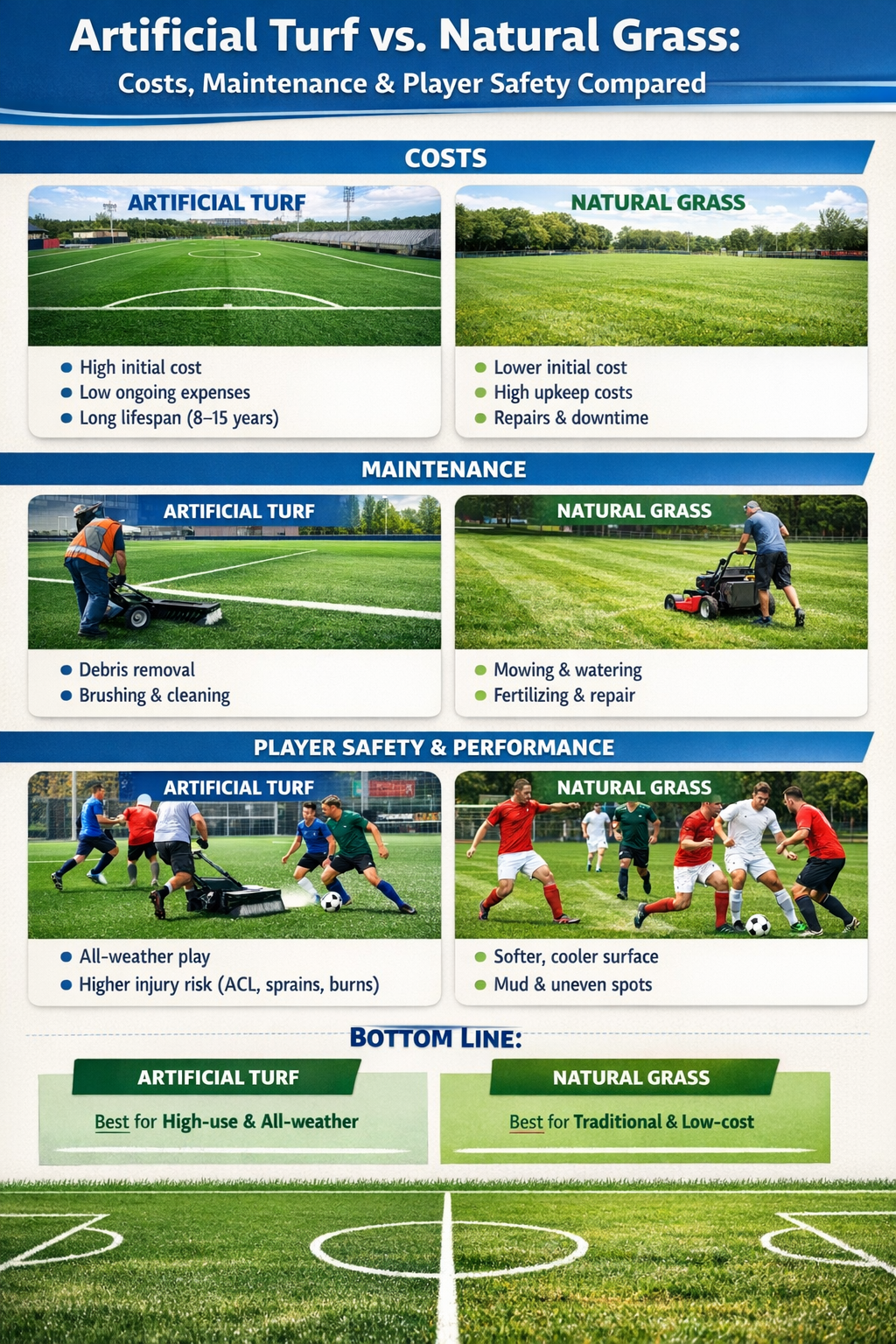
Artificial Turf vs Natural Grass: Costs, Maintenance & Player Safety Compared
Artificial turf offers superior durability, all-weather play, and lower long-term maintenance, making it cost-effective over time despite higher initial costs, while natural grass provides a softer, cooler, more traditional feel but demands extensive upkeep (watering, mowing) and can become unplayable when wet. Player safety is mixed: turf reduces concussion risk but may increase ankle/knee injuries and burns, whereas natural grass offers natural cushioning but wears unevenly, creating hazards.
Costs
-
- Artificial Turf: High initial installation cost (materials, base, labor) but lower ongoing costs (no watering, mowing, fertilizing). Can generate revenue through rentals due to high usage.
-
- Natural Grass: Lower upfront cost but significant long-term expenses for irrigation, fertilization, mowing, and repairs.
Maintenance
-
- Artificial Turf: Minimal, mostly debris removal (sweeping/blowing) and occasional deep cleaning; lasts 8-15 years.
-
- Natural Grass: Intensive: watering, mowing, fertilizing, pest control, and field recovery time.
Player Safety & Performance
-
- Artificial Turf: Consistent ball roll, grip, and traction; excellent drainage for all-weather play. Modern turf has good shock absorption, but some studies link it to higher rates of turf burns, ankle sprains, and ACL injuries due to higher friction.
-
- Natural Grass: Softer, naturally cooler, better shock absorption, preferred feel. Can become muddy, uneven, and wear down quickly, creating tripping hazards and requiring field downtime.
Which is Better?
-
- Choose Turf for: Heavy usage, budget-conscious long-term, all-weather reliability (e.g., multi-use fields, commercial arenas).
-
- Choose Grass for: Premium, lower-traffic fields where budget allows for professional care, natural feel, and environmental benefits (cooling, CO2 absorption) are priorities (e.g., elite-level fields with dedicated groundskeeping).
What Every Coach, Owner, and Facility Planner Needs to Understand About TCO & Safety
For coaches, owners, and planners, understanding Total Cost of Ownership (TCO) and Safety means recognizing that low initial cost often hides high long-term expenses (maintenance, repairs, downtime, energy), while robust safety isn’t just a regulation but a financial and ethical imperative reducing liability, boosting morale, and ensuring operational continuity, directly impacting an asset’s true TCO by preventing costly incidents and improving overall efficiency. It’s about strategic, data-driven decisions that balance upfront investment with lifecycle value, making safety the smartest long-term financial choice, not just a compliance checkbox.
For Owners & Facility Planners (Strategic View)
-
- Total Cost of Ownership (TCO): Don’t just buy the cheapest equipment; consider its full lifecycle: purchase, setup, energy use, maintenance, repairs, downtime, and disposal. A safe, quality asset might cost more upfront but saves significantly over time.
-
- Safety as an Investment, Not an Expense: Prioritize safety features (better materials, design, PPE) to reduce future insurance, accident-related downtime, and legal costs.
-
- Data-Driven Decisions: Use TCO analysis to justify investments in safer, more efficient systems (like better HVAC, lighting, or equipment) that lower operating costs and improve health.
-
- Compliance & Risk Mitigation: Understand regulations to avoid fines, but also proactively assess risks (evacuation plans, equipment guidelines) to protect people and assets.
For Coaches & Facility Managers (Operational View)
-
- People, Processes, Building, Technology: Safety integrates all four pillars: well-trained staff (people) following clear protocols (processes) in a secure environment (building) using smart technology for monitoring (technology).
-
- Proactive Maintenance: Implement preventive maintenance (PM) to catch issues before they become costly failures or safety hazards, directly lowering TCO.
-
- Emergency Preparedness: Have clear, practiced emergency plans (fire, evacuation) to minimize damage and ensure quick, safe recovery, preventing prolonged operational halts.
-
- Culture of Safety: Foster an environment where reporting hazards is encouraged and psychological safety is valued, improving team performance and reducing incidents.
Deciding Between Turf and Natural Grass: JMR’s Analysis of Cost, Longevity & Safety
Choosing the right playing surface is one of the most important decisions for any sports facility, school, stadium, or community ground. Both artificial turf and natural grass deliver unique advantages but their long-term performance, safety profile, durability, and cost of ownership vary significantly. At JMR InfraSolutions, we help clients evaluate these factors with precision so they can invest in a surface that supports performance, sustainability, and long-term value.
Detailed Analysis Of Cost
Artificial turf has a high initial installation cost, often several times that of natural grass. However, the ongoing maintenance costs are significantly lower, primarily involving occasional grooming and cleaning.
Natural grass is inexpensive to install but has higher ongoing expenses for water, fertilizer, pesticides, mowing, and labor.
Long-term cost analyses vary, with some suggesting turf is more cost-effective over a decade due to fewer maintenance hours, while others find natural grass has a lower expense over a 25-year period when factoring in turf replacement costs and environmental impacts.
Longevity
Artificial turf is very durable and designed for heavy use and all weather conditions, making it ideal for sports fields. It typically lasts 10 to 15 years before the entire surface needs to be replaced, which is a significant cost.
Natural grass can last indefinitely if properly maintained. However, it can quickly wear out with heavy foot traffic or poor weather, leading to muddy, unplayable areas that require frequent repair or reseeding.
Safety
Artificial turf surfaces can become significantly hotter than natural grass fields on sunny days (up to 86.5° F hotter), posing a risk of heat exhaustion and burns. Some studies suggest an increased risk of lower extremity injuries requiring surgery on artificial turf compared to grass.
Natural grass provides natural cushioning, absorbs impact, and stays cooler due to evapotranspiration. It is generally considered a softer, more forgiving surface, though a poorly maintained grass field can present its own injury risks like uneven patches.