
What are Stadium Lighting Standards?


Stadium lighting standards are a set of technical guidelines for stadium illumination that include lux levels, uniformity, glare control, color rendering index (CRI), and color temperature, all tailored for different sports and competition levels (e.g., amateur, professional, broadcast). These standards, often defined by organizations like IES and EN 12193, ensure player safety, good visibility for spectators, and high-quality broadcast conditions.
What are the Key factors in stadium lighting standards?
Key factors in stadium lighting standards include illumination levels (lux), glare control, uniform light distribution, and color quality. Other important considerations are energy efficiency, light pollution control, safety (including emergency lighting), and durability to withstand weather.
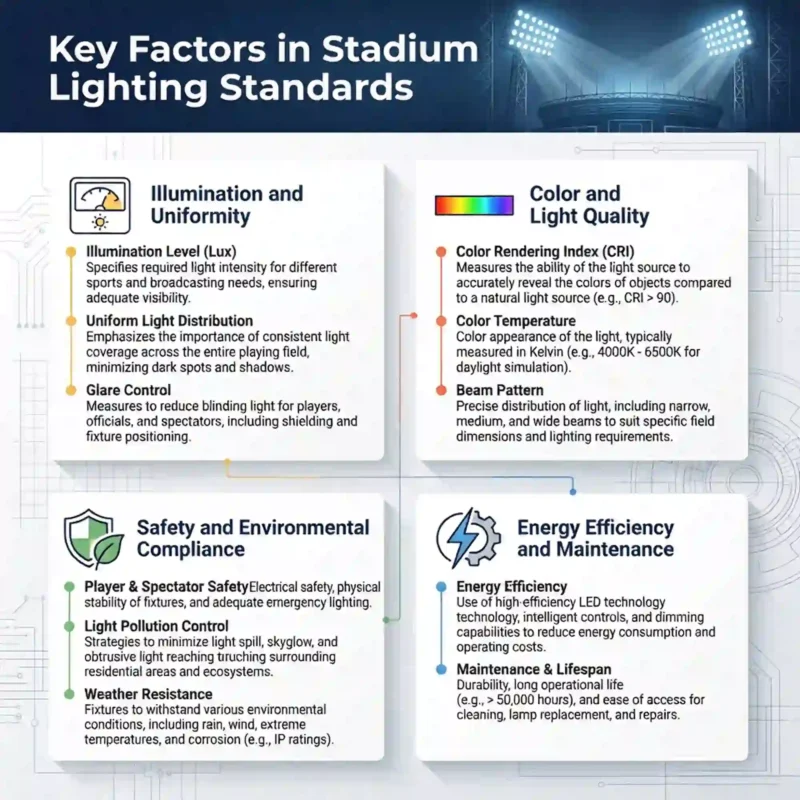
Illumination and uniformity
-
- Illumination level: This is the brightness of the light, measured in lux. The required level varies depending on the sport, competition level, and the distance from spectators.
-
- Uniformity: Lighting should be consistent across the entire playing area to avoid shadows and ensure every part of the field is adequately lit. A high uniformity ratio is desirable.
-
- Glare control: Fixtures must be designed and positioned to prevent glare that could disrupt players or spectators. Shielding and careful placement are crucial.
Color and quality
-
- Color Rendering Index (CRI): A high CRI ensures that colors appear true to life, which is vital for players and for video broadcasts.
-
- Color temperature: The chosen color temperature affects the overall look and feel of the lighting, which can impact visibility and video footage.
-
- Beam pattern: The angle and distribution of light from the fixtures must be carefully planned to ensure it reaches the intended area and avoids wasting light.
Safety and environment
-
- Safety: Lighting must ensure the personal safety of players and provide adequate visibility for spectators entering and exiting the stadium. This includes emergency lighting systems.
-
- Light pollution: Installations should be designed to minimize light spill into surrounding areas, such as residential neighborhoods, and comply with light trespass regulations.
-
- Weather resistance: Luminaires must be durable enough to withstand harsh weather, including wind, rain, and extreme temperatures.
Efficiency and maintenance
-
- Energy efficiency: Modern lighting systems, especially LEDs, are highly energy-efficient, which can significantly lower power consumption and operational costs.
-
- Maintenance: The lighting system should be designed to be durable and have a long lifespan, with components that are easy to replace when needed.
What are the Navigating Core Standards of Sports Lighting?
The core standards for sports lighting involve balancing quantitative metrics (like brightness and uniformity) with qualitative factors (such as glare control and color quality) to ensure safety, performance, and an excellent experience for athletes, spectators, and broadcasters.
Key standards are established by governing bodies like the Illuminating Engineering Society (IES) in North America and the European Standard EN 12193 in Europe
Core Standards and Metrics
-
- Illuminance (Brightness): This refers to the amount of light hitting the playing surface, measured in lux (lx) or foot-candles (fc). The required level varies significantly based on the level of play.
-
- Recreational/Training (Class III/IV): Lower requirements, typically around 200–300 lux.
-
- Collegiate/Semi-Pro (Class I/II): Medium requirements, often around 500–1000 lux.
-
- Professional/Broadcast (Class I): Highest requirements, often exceeding 1000 lux for high-definition TV coverage.
-
- Illuminance (Brightness): This refers to the amount of light hitting the playing surface, measured in lux (lx) or foot-candles (fc). The required level varies significantly based on the level of play.
-
- Uniformity: This is a crucial metric ensuring even light distribution across the field, preventing shadows or overly bright spots that can hinder performance or visibility. It is expressed as a ratio (e.g., 2:1 or 1.5:1), with a lower ratio indicating better uniformity.
-
- Glare Control: Glare can distract players and spectators, and must be minimized through careful fixture selection (e.g., low-glare optics) and appropriate pole heights.
-
- Color Properties:
-
- Color Temperature: Measured in Kelvin (K), this determines the “warmth” or “coolness” of the light. Sports lighting usually requires a cooler temperature, typically between 4000K and 6500K, to enhance visibility and alertness.
-
- Color Rendering Index (CRI): A high CRI (usually above 80) is essential, especially for televised events, to ensure accurate color reproduction of objects and uniforms.
-
- Color Properties:
-
- Flicker-Free Operation: High-frequency drivers in modern LED systems eliminate flicker, which is vital for high-speed action and high-definition video capture, including slow-motion replays.
Operational and Safety Standards
-
- Energy Efficiency & Smart Controls: Modern standards favor energy-efficient LED technology combined with smart control systems (dimming, scheduling, sensors) to reduce operational costs and energy consumption.
-
- Safety and Weatherization: Systems must adhere to local electrical and building codes and international safety standards like IEC 60598. Outdoor systems require robust weatherization (e.g., IP65 ratings) to withstand environmental factors.
-
- Compliance with Governing Bodies: Each sport’s governing body (e.g., FIFA for soccer, IES for general sports) publishes specific guidelines for different competition levels. Adhering to these is mandatory for certification and safe operation.
What are the Four Pillars of Stadium Lighting Standards?
The four primary pillars (or key factors) of modern stadium lighting standards are Illuminance, Uniformity, Glare Control, and Color Quality (including Color Temperature and Color Rendering Index). These standards ensure optimal visibility and performance for players, spectators, and television broadcasts.
-
- Illuminance: This refers to the amount of light (measured in lux or footcandles) that reaches the playing surface. The required illuminance level varies significantly depending on the level of play, ranging from amateur practice to professional leagues and HDTV broadcasts, with higher levels needed for professional and televised events.
-
- Uniformity: Uniformity ensures that the light is evenly distributed across the entire field of play, preventing dark spots or overly bright areas. A consistent light level is essential so that players’ and cameras’ eyes do not have to constantly adjust to different brightness levels, which can cause eye strain and affect performance.
-
- Glare Control: Glare is excessive brightness that causes visual discomfort or reduces the visibility of objects. Effective glare control is crucial for players and spectators alike to ensure safety and an uninterrupted view of the game. This is often managed through careful luminaire positioning, beam angle control, and modern optical designs.
-
- Color Quality: This encompasses two aspects:
Color Rendering Index (CRI): CRI measures how accurately colors appear under the light source compared to natural light. A high CRI is particularly important for high-definition television broadcasting to ensure that colors (e.g., team uniforms, field colors) are vibrant and true to life.
Color Temperature (CCT): CCT, measured in Kelvin, determines whether the light appears warm (yellowish) or cool (bluish-white). Cooler temperatures (typically 5000K+) are generally preferred in sports lighting as they enhance visibility and visual acuity.
Adherence to these standards, often set by bodies like the European Committee for Standardization (EN 12193) or FIFA, is critical for a safe, enjoyable, and professional sporting environment.
Understanding the Complex Science of Stadium Lighting Standards
The complex science of stadium lighting standards balances the need for high visibility for players and spectators, quality for high-definition broadcasts, and energy efficiency. These standards are primarily set by governing bodies like the Illuminating Engineering Society (IES) and the International Commission on Illumination (CIE), and specific sports federations such as FIFA and the NFL.
Key Scientific and Design Principles
Stadium lighting is a sophisticated engineering challenge that goes beyond mere brightness. Key factors include:
-
- Illuminance Levels (Lux/Foot-candles): This measures the amount of light that falls on the playing surface. Requirements vary significantly by the level of play and sport:
-
- Recreational/Training: Lower levels (e.g., 20-50 foot-candles for a football field) are sufficient.
-
- Professional/Televised Events: High-level events require much greater illumination (e.g., 100-250+ foot-candles, or 1,000-2,000 lux) to ensure clarity for players and broadcast cameras.
-
- Illuminance Levels (Lux/Foot-candles): This measures the amount of light that falls on the playing surface. Requirements vary significantly by the level of play and sport:
-
- Uniformity: Even light distribution across the field is critical to prevent shadows or dark spots that can impair player performance and the viewing experience. Standards often require a high uniformity ratio (e.g., 0.7 or better).
-
- Glare Control: Glare can be a major distraction or even a safety hazard for athletes and fans. Modern lighting systems use advanced optics and precise aiming to minimize glare, often with a specified maximum glare rating (GR).
-
- Color Quality (CRI and CCT): The Color Rendering Index (CRI) measures how faithfully colors appear under the light. A high CRI (80+ is good, 90+ is ideal for HD broadcasts) ensures that team uniforms and the field appear natural. Correlated Color Temperature (CCT), typically in the 4000K to 6000K range, provides a crisp, daylight-like appearance.
-
- Flicker Control: For high-speed cameras used in slow-motion replays, lighting must be flicker-free. High-frequency LED drivers ensure consistent light output that high-frame-rate cameras can capture without strobing effects.
-
- Installation Height and Placement: Taller poles (up to 100+ feet for professional stadiums) and strategic placement are essential for achieving optimal light distribution and minimizing glare and light pollution.
The Role of Technology and Standards
The shift from traditional metal halide lamps to LED technology has revolutionized stadium lighting by offering superior energy efficiency, longer life, instant on/off capabilities, and intelligent control options. These advancements make it easier to meet stringent modern standards, which are continuously evolving to accommodate ultra-high-definition (4K and 8K) broadcasting demands and sustainability goals, including local dark-sky ordinances.
What are the requirements for a Beginner’s Guide to Stadium Lighting?
A beginner’s guide to stadium lighting requires addressing the core requirements of illumination level, uniformity, and glare control. It should also cover technical aspects like appropriate color temperature, LED technology, and the physical design of light poles. Key factors for a beginner include considering energy efficiency, durability, and compliance with relevant sports standards, as well as consulting with professionals for a photometric study and final design.
Core lighting quality
-
- Illumination level: Ensure enough light is provided for players, officials, and spectators, with higher requirements for professional games (e.g., over 1500 lux) compared to recreational use (e.g., 30-50 foot-candles).
-
- Uniformity: Light must be distributed evenly across the playing area to prevent shadows and ensure consistent visibility everywhere on the field.
-
- Glare control: Minimize glare to prevent visual discomfort and protect players’ eyes, often achieved through high mounting heights and fixtures with proper shielding.
Technical specifications
-
- LED technology: Modern systems should use LED lights for energy efficiency, long lifespan, and better glare control.
-
- Color temperature: Choose a color temperature that enhances visibility and is suitable for television broadcasts, typically between 5000K and 5700K.
-
- Color rendering index (CRI): The CRI should be high enough to render colors accurately, which is crucial for both players and broadcasting.
-
- Beam angle: Use fixtures with the correct beam angle, often narrow, to direct light efficiently onto the field and minimize wasted light or spillover.
Practical and design considerations
-
- Energy efficiency and cost: Select energy-efficient lighting to reduce operational costs.
-
- Pole design and height: Use tall poles to improve light distribution and reduce glare. The pole material should be durable, and the design should be integrated with the stadium’s aesthetic.
-
- Weather resistance: Ensure the lighting system is built to withstand the elements for outdoor venues.
-
- Maintenance and flexibility: Choose fixtures that are easy to install and maintain. Consider smart systems for adjustable lighting, dimming, and scheduling, especially for multi-use venues.
Standards and professional advice
-
- Adhere to standards: Follow specific sports lighting standards (e.g., from organizations like FIFA or ANSI/IES) depending on the type of sport and level of competition.
-
- Consult professionals: Obtain professional help for a photometric study, which is essential for designing the system to meet all performance requirements, especially for large or professional venues.