
Planning and Designing Multi-Sport Complexes for Maximum Impact

Successful sports infrastructure projects require a strategic blend of visionary architecture and precise engineering. Planning and designing multi-sport complexes for maximum impact involves creating spaces that serve professional athletes, local communities, and commercial stakeholders simultaneously. Modern facility development has shifted toward versatile, high-performance environments that prioritize operational efficiency while fostering deep community engagement. Whether you are a developer, contractor, or sports authority, understanding the interplay between site utilization and technical requirements is critical for project success.
At JMR InfraSolutions, we provide comprehensive sports infrastructure solutions that bridge the gap between initial concepts and operational excellence through professional stadium construction and site development.
Overview of Multi-Sport Complex Development
Developing a multi-sport complex is a multifaceted undertaking that demands a clear understanding of long-term goals. The development process begins with site assessment and feasibility studies, ensuring the chosen location can handle the projected capacity and traffic. A well-planned facility acts as a hub for both athletic performance and social activity. By integrating stadium construction expertise early in the planning phase, owners can ensure that structural layouts support diverse athletic activities, from track and field events to indoor court games. Strategic planning also accounts for future scalability, allowing the facility to evolve as community needs change.
Why Strategic Planning Matters
Strategic planning is crucial for stadiums because they are high-cost, multi-purpose, and long-term infrastructure investments that must serve varied stakeholders, fans, athletes, and commercial partners year-round. A well-defined strategy transforms a stadium from a simple sports venue into a year-round entertainment hub that drives financial sustainability, operational efficiency, and enhanced fan experiences.
Key Reasons It Matters
1. Optimizes Design and Functionality
Proper planning ensures the stadium meets requirements for capacity, sightlines, accessibility, and multi-sport usage.
2. Maximizes Revenue Potential
Strategic layouts and features (VIP seating, retail zones, events) help generate multiple income streams beyond match days.
3. Enhances Fan Experience
Planning enables smooth crowd flow, better seating comfort, digital engagement, and overall spectator satisfaction.
4. Supports Future Expansion
A well-planned stadium can be easily upgraded or expanded as demand grows.
5. Improves Operational Efficiency
Integration of smart systems (lighting, security, maintenance) reduces long-term operational costs.
6. Ensures Sustainability
Strategic planning incorporates eco-friendly solutions like energy-efficient lighting, water management, and green materials.
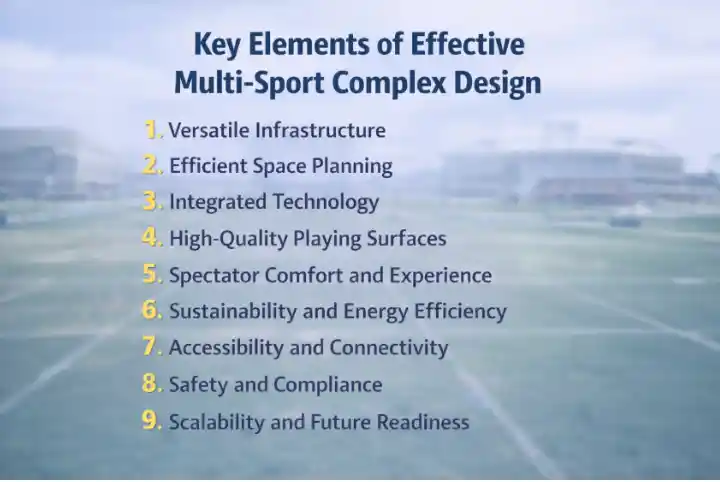
Key Elements of Effective Multi-Sport Complex Design
Designing a successful multi-sport complex requires a strategic balance of functionality, flexibility, technology, and user experience. A well-planned complex can serve diverse sports, maximize utilization, and deliver long-term value.
1. Versatile Infrastructure
Multi-sport complexes should be designed to accommodate different sports within the same space. Convertible fields, modular courts, and adaptable layouts ensure maximum usage and flexibility.
2. Efficient Space Planning
Optimizing space is critical to avoid congestion and improve flow. Shared facilities like locker rooms, parking areas, and common zones help reduce redundancy and improve efficiency.
3. Integrated Technology
Modern complexes incorporate smart technologies such as IoT-enabled lighting, digital displays, surveillance systems, and access control to enhance operations and user experience.
4. High-Quality Playing Surfaces
The choice of turf or surface must meet international standards for performance, safety, and durability, ensuring a professional experience for athletes.
5. Spectator Comfort and Experience
Seating design, visibility, accessibility, and amenities like restrooms and food courts play a crucial role in enhancing the overall fan experience.
6. Sustainability and Energy Efficiency
Incorporating eco-friendly practices such as energy-efficient lighting, water conservation systems, and sustainable materials reduces environmental impact and operational costs.
7. Accessibility and Connectivity
The complex should be easily accessible via roads and public transport, with proper parking and clear navigation for visitors.
8. Safety and Compliance
Ensuring safety standards, emergency exits, crowd management systems, and compliance with regulations is essential for smooth operations.
9. Scalability and Future Readiness
A well-designed complex should allow for future expansion and integration of new technologies as needs evolve.
Benefits of Multi-Sport Complexes
Multi-sport complexes are more than just sports facilities, they are dynamic hubs that deliver social, economic, and developmental value to communities and stakeholders.
1. Maximized Utilization of Space
By hosting multiple sports and activities in one location, these complexes ensure continuous usage instead of underutilized single-purpose facilities.
2. Cost Efficiency
Shared infrastructure such as seating, lighting, parking, and amenities helps reduce construction and operational costs.
3. Enhanced Community Engagement
Multi-sport complexes act as community hubs where people gather for sports, events, and recreational activities, strengthening social connections.
4. Supports Athlete Development
Access to diverse sports facilities enables athletes to train across disciplines, promoting skill development and talent growth.
5. Increased Revenue Opportunities
These complexes can host tournaments, events, concerts, and leagues, creating multiple revenue streams beyond regular sports usage.
6. Promotes Health and Active Lifestyles
With easy access to various sports and fitness activities, communities are encouraged to adopt healthier lifestyles.
7. Flexibility and Multi-Purpose Use
Facilities can be adapted for different sports and non-sporting events, making them highly versatile and future-ready.
8. Boosts Local Economy
Multi-sport complexes attract visitors, generate employment, and support nearby businesses, contributing to economic growth.
9. Encourages Grassroots Sports Development
By providing accessible infrastructure, these complexes help nurture young talent and promote sports at the grassroots level.
10. Long-Term Sustainability
Efficient design, shared resources, and modern technologies ensure sustainable operations and reduced environmental impact.
The Role of Turnkey Solutions in Maximizing Impact
Turnkey solutions play a critical role in maximizing impact by providing fully integrated, ready-to-use systems that streamline project execution, reduce risks, and accelerate time-to-market. These “one-stop-shop” solutions covering everything from design and procurement to installation and commissioning allow businesses to “turn the key” and begin operations immediately, minimizing the administrative burden of managing multiple vendors.
1. Seamless Project Execution
With a single point of responsibility, all stages of the project are well-coordinated, reducing delays and ensuring smooth execution.
2. Faster Time-to-Completion
Integrated planning and execution help eliminate bottlenecks, enabling quicker project delivery without compromising quality.
3. Cost Efficiency and Budget Control
Turnkey projects reduce cost overruns by streamlining procurement, minimizing errors, and ensuring better financial planning.
4. Consistent Quality Standards
From design to implementation, every aspect follows a unified quality benchmark, resulting in high-performance infrastructure.
5. Integrated Technology Implementation
Turnkey solutions ensure seamless integration of technologies such as smart lighting, LED displays, and digital systems within the infrastructure.
6. Reduced Risk and Complexity
With one accountable partner, risks related to coordination, delays, and miscommunication are significantly minimized.
7. Customization and Scalability
Turnkey providers design solutions tailored to specific project needs while keeping future expansion and upgrades in mind.
8. Improved Operational Readiness
Projects are delivered fully functional and ready to operate, reducing downtime and enabling immediate utilization.
Maximizing Impact: Performance, Durability, and Community Value
The true value of a sports complex lies in its performance capabilities and its ability to withstand constant wear. High-performance facilities require surfaces that prioritize athlete safety, such as advanced turf solutions designed for specific sport requirements. Durability is achieved through the selection of premium materials that resist environmental degradation and heavy usage.
Furthermore, community value is maximized when the facility remains accessible and inclusive, incorporating features that cater to diverse age groups and skill levels. When stakeholders invest in quality infrastructure, they ensure a long-term return on investment that goes beyond revenue generation to include health and social benefits.
Integrated Technologies: Lighting, Turf, and Seating
Technological integration is what elevates a standard complex into a premier venue. Precision sports lighting solutions are essential for extending the operational hours of a facility and ensuring optimal visibility for athletes and spectators. These systems must be energy-efficient and compliant with broadcast standards. Additionally, the installation of LED display boards and advanced scoreboards enhances the fan experience by providing real-time data and high-definition visuals. Complementing these technologies with professional irrigation systems ensures that turf longevity is preserved even in challenging climates.
Looking to build a future-ready multi-sport complex?
Partner with JMR InfraSolutions for end-to-end turnkey sports infrastructure solutions from concept and design to execution and delivery. Create high-performance, sustainable, and impactful sports environments tailored to your vision.
ADD A CONVERSION BANNER HERE.
FAQs
1. What is the main purpose of a multi-sport complex?
A multi-sport complex is designed to host multiple sports and recreational activities in one integrated facility, maximizing usage and community impact.
2. How does a multi-sport complex benefit communities?
It promotes health, supports youth development, creates jobs, and strengthens community engagement.
3. What technologies are used in modern sports complexes?
Technologies include IoT-based systems, LED lighting, digital scoreboards, surveillance systems, and smart access controls.
4. Why is flexibility important in sports complex design?
Flexible design allows facilities to host various events and adapt to changing needs, improving utilization and ROI.
5. How can sustainability be incorporated into sports complexes?
Through energy-efficient systems, renewable energy sources, water conservation methods, and eco-friendly materials.
6. What is a turnkey sports infrastructure solution?
It is a complete end-to-end service covering design, construction, and delivery under a single provider.
7. How long does it take to build a multi-sport complex?
The timeline varies depending on scale and complexity but is typically reduced with turnkey execution.
8. What factors should be considered when choosing a location?
Accessibility, connectivity, population demographics, and available space are key factors.
9. Can multi-sport complexes host non-sporting events?
Yes, they are often designed to host concerts, exhibitions, and community events.
10. How do multi-sport complexes improve ROI?
By increasing utilization, attracting diverse events, and reducing operational costs through efficient design and technology.