
Solar-Powered High Mast Lighting for Sports and Public Infrastructure

As sustainability becomes central to infrastructure development, solar-powered high mast lighting is transforming how sports venues and public spaces are illuminated. Rising energy costs, environmental regulations, and the need for uninterrupted lighting have pushed governments and developers toward renewable solutions.
Solar-powered high mast lighting combines advanced LED technology with renewable energy systems to deliver efficient, reliable, and eco-friendly illumination for sports complexes, highways, public grounds, parking areas, industrial zones, and urban infrastructure.
What Is Solar-Powered High Mast Lighting?
Solar-powered high mast lighting is a self-contained, elevated lighting system (typically 6–30+ meters) that provides high-intensity, wide-area illumination using solar panels, batteries, and LED technology. It operates independently of the utility grid, making it ideal for ports, highways, stadiums, and remote areas.
Why Solar High Mast Lighting Is Gaining Momentum
Solar high mast lighting is gaining significant momentum due to its energy efficiency, zero electricity costs, and long-term savings, making it ideal for illuminating large areas like highways, ports, and stadiums. These systems are environmentally friendly, operate independently of the grid, and require minimal maintenance, driving adoption in sustainable infrastructure projects.
Key Reasons for Momentum:
-
- Cost-Effectiveness & Energy Independence: By utilizing solar power, these systems eliminate electricity bills and reduce dependency on the grid, which is particularly beneficial in remote locations.
-
- Sustainability & Eco-Friendliness: They significantly reduce carbon footprints by relying on renewable energy rather than fossil fuels.
-
- Low Maintenance & High Durability: The combination of LED technology with durable, rugged materials (such as galvanized steel) ensures long operational life.
-
- No Trenching or Cabling: Installation is simpler and more cost-effective because they do not require extensive digging or grid connection infrastructure, minimizing disruption to existing areas.
-
- Advanced Technology & Smart Features: Modern units feature automatic dawn-to-dusk sensors, lithium-ion battery backups, and smart controllers for optimized performance and remote monitoring.
-
- Enhanced Safety and Uniformity: These lights provide high-intensity, uniform illumination, enhancing security in public spaces, parking lots, and industrial zones.
Technical Advantages of Solar High Mast Systems
Solar high mast systems offer superior, energy-efficient, and autonomous lighting for large areas, utilizing high-output LED fixtures and photovoltaic panels to eliminate electricity costs and grid dependency. Key advantages include, off-grid capability with built-in battery storage, advanced automated controls, robust structural durability, and minimal maintenance needs.
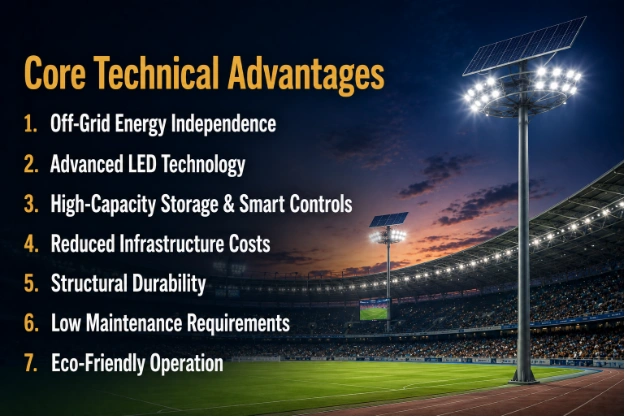
Core Technical Advantages
-
- Off-Grid Energy Independence: Operating independently of the utility grid, these systems are ideal for remote locations, highways, and disaster-prone areas, ensuring “uninterrupted lighting”.
-
- Advanced LED Technology: Utilizing high-lumen LED modules, these systems provide high-efficiency, uniform light distribution over massive areas (e.g., ports, stadiums) while reducing power consumption and heat output.
-
- High-Capacity Storage & Smart Controls: Systems often use Lithium Iron Phosphate (LiFePO4) batteries and MPPT controllers for optimized charging, along with intelligent, “dusk-to-dawn” controllers and dimming capabilities.
-
- Reduced Infrastructure Costs: The elimination of trenching for grid cabling significantly lowers installation costs and, “makes them valuable particularly in rural areas”.
-
- Structural Durability: Designed with hot-dip galvanized, high-strength steel, they are engineered to withstand high wind speeds and harsh weather, with specialized designs available for coastal locations.
-
- Low Maintenance Requirements: Solid-state LED lighting reduces the need for frequent, “replacement of bulbs”, offering a long operational life.
-
- Eco-Friendly Operation: These systems produce zero emissions, “contributing to a greener environment”.
The Future of Sustainable Sports Lighting
As infrastructure development shifts toward green and smart technologies, solar-powered high mast lighting will become increasingly mainstream.
Future innovations may include:
-
- AI-based energy optimization
-
- Integrated smart city connectivity
-
- Hybrid solar-grid systems
-
- Real-time energy analytics dashboards
Solar lighting is not just a renewable option it represents the future of resilient and intelligent infrastructure.