
The Role of High-Mast and Flood Lighting in Sports Venues

Modern sports venues demand more than just illumination, they require precision-engineered lighting systems that enhance performance, ensure safety, and meet international broadcast standards. High-mast and flood lighting systems play a critical role in defining the functionality and global readiness of any stadium or sports complex.
Why High-Mast Lighting Matters
High-mast lighting is critical for providing uniform, widespread illumination across large, open areas like highways, ports, and stadiums from 12 to 60-meter poles. It significantly improves safety by enhancing visibility, reducing accidents, and minimizing shadows. These systems also reduce visual clutter, improve security, and offer durable, energy-efficient, long-term solutions for infrastructure.
The Function of Flood Lighting in Stadiums
Stadium floodlighting provides high-intensity, uniform illumination across playing surfaces, crucial for hosting evening matches, enhancing safety, and ensuring optimal visibility for players, spectators, and television broadcasting. These systems eliminate shadows, allowing for accurate, high-definition (HD) footage while supporting extended, safe, and, with modern LED solutions, energy-efficient operational hours.
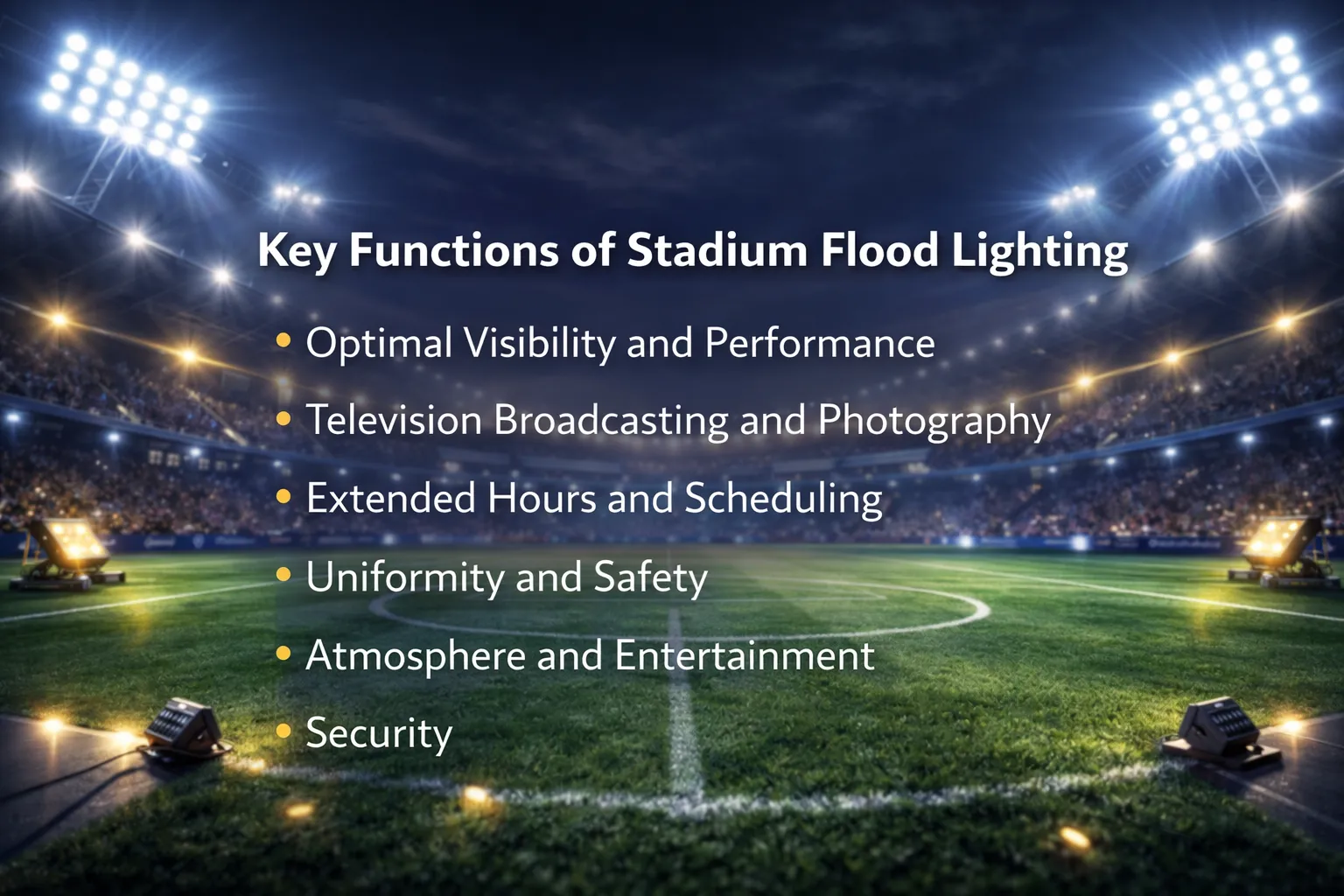
Key Functions of Stadium Flood Lighting:
-
- Optimal Visibility and Performance: Floodlights ensure athletes can clearly see the ball, field, and teammates, reducing injury risks caused by poor lighting.
-
- Television Broadcasting and Photography: Modern, high-lumen, flicker-free LED lights meet the rigorous requirements for HD broadcasting and slow-motion replays.
-
- Extended Hours and Scheduling: They enable matches and training sessions to take place outside of daylight hours, catering to evening crowds and prime-time TV.
-
- Uniformity and Safety: They eliminate bright hotspots and dark zones across the field, crucial for safety and for maintaining a level playing field.
-
- Atmosphere and Entertainment: Modern LED systems allow for dynamic lighting, including dimming, color changes, and light shows for pre-match or halftime events.
-
- Security: These lights enhance safety by illuminating the surrounding spectator areas, walkways, and parking lots to deter intruders.
Key Benefits of Flood Lighting
Flood lighting provides high-intensity, broad-beamed illumination, offering significant benefits including enhanced security, improved safety in low-light conditions, and exceptional energy efficiency (especially with LED technology). They are durable, long-lasting, and ideal for illuminating large areas like parking lots, sports fields, and construction sites while reducing maintenance costs.
Key Benefits of Flood Lighting:
-
- Enhanced Security: The high-intensity light acts as a deterrent to intruders, safeguarding residential and commercial properties.
-
- Improved Safety and Visibility: Illuminates driveways, pathways, and dark, large areas to reduce accidents and enhance visibility.
-
- Energy Efficiency (LEDs): Modern LED floodlights consume significantly less electricity, reducing operational costs compared to traditional halogen or HID lamps.
-
- Longer Lifespan & Low Maintenance: LEDs offer extended operating hours, reducing the need for frequent replacements.
-
- Durability and Weather Resistance: Designed to withstand harsh, changing weather conditions, making them ideal for outdoor, year-round use.
-
- Versatility in Application: Suitable for security, sports fields, stadiums, landscape lighting, and commercial/industrial sites.
-
- Instant-On Functionality: Unlike older lighting, LEDs provide instant illumination without a warm-up period.
-
- Environmental Friendly: They lack hazardous materials like mercury and reduce carbon footprints due to lower energy consumption.
High-Mast vs Flood Lighting: Complementary Systems
High-mast and floodlighting are complementary, high-efficiency systems for large-area illumination. High-mast (50–150+ ft) provides uniform, widespread coverage with minimal ground obstruction for vast areas, while floodlighting offers directional, high-intensity lighting for specific, smaller, or high-activity zones. Together, they maximize safety, visibility, and energy efficiency.
High-Mast vs. Flood Lighting Comparison
| Feature | High-Mast Lighting | Flood Lighting |
| Mounting Height | Very High (typically 50–150+ feet) | Low to High (typically 20–50 feet, or on buildings) |
| Primary Purpose | Broad, uniform, large-area coverage | Targeted, directional, or accent lighting |
| Pole Requirements | Fewer, taller poles; 3–12+ fixtures per pole | Multiple poles or mounting on structures |
| Light Distribution | Wide, uniform, and often 360-degree | Narrower, customizable, and directional |
| Typical Applications | Airports, highway interchanges, cargo ports, large parking lots | Building exteriors, sports fields, security areas, smaller parking lots |
| Key Advantage | Minimizes ground obstructions; reduces glare | Flexible aiming; high intensity in specific spots |
| Complementary Role | Provides, safe, even ambient light over a broad, open space | Fills in shadows, boosts brightness on specific, high-use areas |
The JMR InfraSolutions Advantage
JMR InfraSolutions delivers end-to-end sports infrastructure solutions, including:
-
- High-mast lighting systems
-
- LED flood lighting installations
-
- Smart control integration
-
- International compliance design
-
- Turnkey execution from planning to commissioning
Our precision-driven approach ensures uniform illumination, energy efficiency, and compliance with global safety standards.